

TL;DR:
- A brand story explains why a luxury or fashion brand exists, its beliefs, and customer transformation, serving as a consistent narrative across all touchpoints. It requires constructing a structured system, including a core Narrative Spine, evidence-backed purpose, and channel-specific layers, to build meaningful and scalable storytelling. Most failures stem from lacking this architecture, emphasizing operational discipline, specificity, and external testing to ensure enduring and authentic brand narratives.
A brand story is a foundational narrative that explains why your brand exists, what it believes, and how it transforms the lives of the people it serves. For fashion and luxury brands, this narrative is not a seasonal campaign or a tagline. It is the through-line that runs through every product, every campaign, and every customer interaction. HubSpot positions brand stories as consistent over time, not refreshed with each collection drop. Brands like Golden Goose and Okhtein demonstrate that the most powerful stories in luxury are built on specificity, evidence, and a deliberate narrative architecture that scales without losing its soul.
What creating a brand story actually requires
Creating a brand story, or what strategists call building a brand narrative, means constructing a structured system, not writing a single paragraph of copy. HubSpot’s four-pillar model organizes this system around People, Places, Purpose, and Plot. People are the protagonists: founders, artisans, or customers whose lives the brand changes. Places provide market context and cultural grounding. Purpose defines the values that drive every decision. Plot is the narrative arc that connects origin to present to future.
These four pillars give you the raw material. What turns them into a scalable narrative is what Diana Socaciu calls Narrative Architecture: a Narrative Spine sentence that links hero, ordinary world, transformation, and special world, supported by Narrative Layers that adapt the story for different channels and audiences while preserving the core arc. The difference between a brand with a story and a brand with a narrative architecture is the difference between a single photograph and a film. One captures a moment; the other builds meaning over time.
The core elements of a well-built brand narrative include:
- Narrative Spine: One sentence that captures the hero, the problem, the transformation, and the destination
- Protagonist: A real person or customer type with a felt, specific problem, not a demographic abstraction
- Purpose: A values statement grounded in evidence, not aspiration alone
- Plot: A sequence of events that includes a turning point, not just a founding date
- Voice: Tone and register that match the brand’s market positioning, whether confident and spare or warm and textured
Pro Tip: Write your Narrative Spine sentence before any other copy. If you cannot summarize your brand’s transformation in one sentence, your story does not yet have a spine. Every piece of content you create should be traceable back to that sentence.
Most failures in brand storytelling come from lacking a deliberate narrative system rather than an inability to write well. A luxury brand with ten team members across three markets will produce inconsistent messaging without a shared architecture. Governance and periodic narrative audits are not optional extras. They are the operational infrastructure that keeps the story coherent as the brand grows.
How to craft a memorable, differentiated brand story
The fastest way to make a brand story forgettable is to open with a template. “Founded in 2018 by a visionary entrepreneur who wanted to change the industry” is not a story. It is a placeholder. InstantPress contrasts this with specific moment openings like “the call came on a Tuesday,” which immediately place the reader inside a real experience. Specificity is the primary differentiator between a brand story that resonates and one that disappears.
The protagonist must carry a real, felt problem. Not “consumers wanted better quality” but a precise frustration, gap, or desire that the founder or customer experienced in a specific context. Golden Goose encodes this specificity through founding dates, the founders’ Venetian background, and a kintsugi-inspired design philosophy that treats wear and imperfection as beauty. These are not decorative details. They are repeatable heritage elements that any team member can use to anchor a campaign, a product description, or a press release.
The Egyptian accessories brand Okhtein goes further. It operationalizes Fatimid Dynasty architecture into a living design system, using geometric motifs and product naming conventions drawn directly from that heritage. This is what separates a brand story from a brand history. A history is a timeline. A story is a system of meaning that informs every design decision.
“The turn is where the story earns its power. Without a transformational moment, you have a biography, not a narrative.” This is the structural move most luxury brands skip, jumping from origin to present without showing what changed and why it mattered.
- Open with a specific moment, not a founding year
- Name the protagonist and their precise problem
- Describe the ordinary world before the brand existed
- Identify the turn: the moment the solution became possible
- Show the special world the brand creates for its customers
Pro Tip: Test your brand’s voice by reading the story aloud. Brand voice must match positioning: a confident, minimal luxury brand should sound nothing like a warm, community-driven fashion label. If the voice feels borrowed, it probably is.
How to develop and activate your brand story across channels
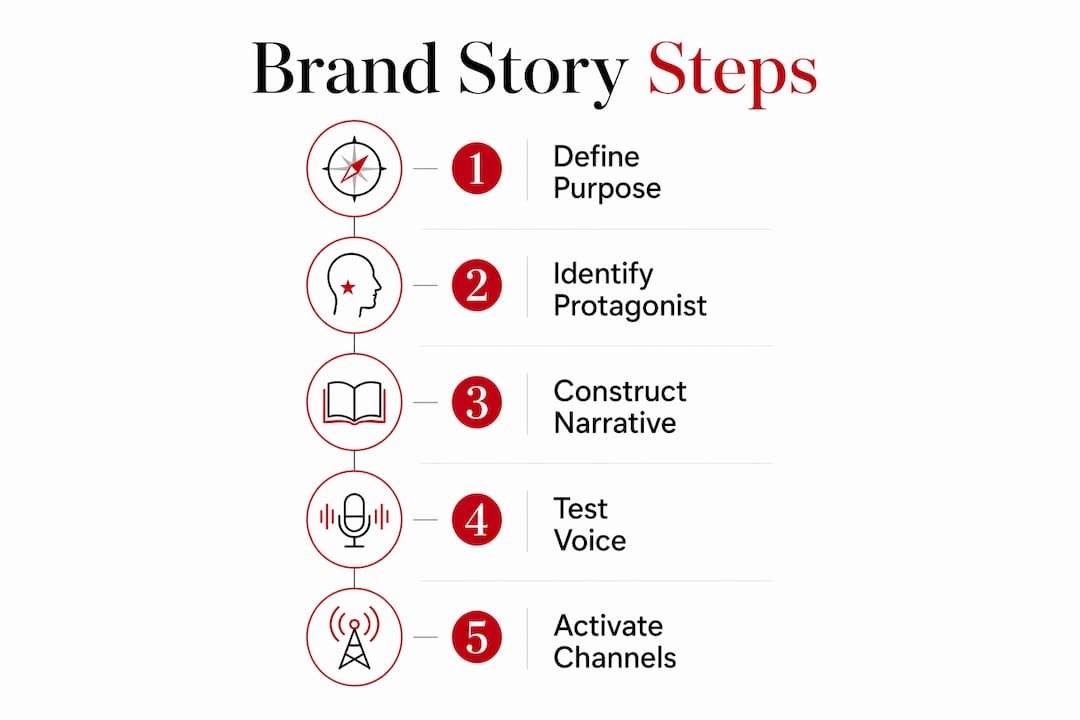
Moving from a written brand narrative to a live, measurable storytelling system requires six deliberate steps. Each one builds on the last, and skipping any of them produces the inconsistency that erodes trust over time.
- Define the core narrative. Write the Narrative Spine sentence. Confirm the four pillars. Document the protagonist, the turn, and the purpose with evidence, not aspiration.
- Map the customer journey. Identify every touchpoint where the story is encountered: discovery, consideration, purchase, post-purchase, and advocacy. Each stage requires a different narrative emphasis.
- Choose channels deliberately. Instagram Reels, product pages, press releases, and packaging each demand a different story format. The spine stays constant; the layer adapts.
- Create story assets. Build a story arsenal: founder video, origin editorial, product narrative templates, and campaign briefs that all trace back to the Narrative Spine. This gives your team flexible content without narrative drift.
- Activate the story. Launch with the channel most aligned to your audience’s discovery behavior. For luxury fashion, this is often editorial coverage and curated social content before paid media.
- Measure impact. Patagonia’s 2026 DTC creative overhaul demonstrated that story-led creative can increase returning customer purchase frequency by 29% and video completion rates by 41%. These are the benchmarks worth tracking: repeat purchase rate, content completion, and brand recall in post-purchase surveys.
The table below shows how the same core narrative adapts across three key channels for a luxury fashion brand.
| Channel | Story emphasis | Format |
|---|---|---|
| Instagram editorial | Protagonist and aesthetic world | Short-form video, carousel |
| Product page | Purpose and craft evidence | Long-form copy, material detail |
| Press release | Heritage and turning point | Narrative-led, quote-driven |
| Email to existing customers | Transformation and community | Personal, first-person tone |
Pro Tip: Build a story arsenal before you activate. A story arsenal is a documented set of narrative assets, including the Narrative Spine, three to five origin moments, and ten to fifteen proof points, that any team member can draw from. This prevents brand story drift when campaigns are produced under time pressure.
How to avoid common brand storytelling pitfalls
The most common failure in luxury brand storytelling is a purpose claim with no proof. “We believe in timeless beauty” is not a purpose. It is a sentence that every competitor could also publish. Luxury founders must ground narratives in evidence, using specific decisions, materials, sourcing choices, or design commitments that demonstrate the claim rather than assert it.
The second failure is the tagline trap: mistaking a slogan for a story. A tagline is a compression of the story, not a substitute for it. Brands that rely on taglines without an underlying narrative architecture cannot answer follow-up questions from journalists, retail partners, or customers who want to know more.
Use these diagnostic questions to test your brand story before it goes live:
- Can a team member who did not write the story retell it accurately in two minutes?
- Does the story include a specific moment, not just a founding year?
- Is the purpose claim supported by at least two concrete decisions or design choices?
- Does the voice match the brand’s market positioning?
- Would a customer recognize themselves in the protagonist’s problem?
Andi Cross recommends having outsiders retell the story to test its repeatability and believability. If the retelling loses the turn or the protagonist’s problem, the story is not yet clear enough. Revision loops with external audiences are not a sign of weakness. They are the operational practice that separates brands with durable narratives from those that rebrand every three years.
Heritage over-indexing is a specific risk in luxury. A brand that leads entirely with its archive and founding date without connecting that heritage to a present-day customer transformation sounds like a museum, not a living brand. The heritage-to-relevance connection is the narrative move that keeps legacy brands competitive.
Key takeaways
A brand story only scales when it is built as a narrative architecture, not a single piece of copy, with a Narrative Spine, evidence-backed purpose, and channel-specific layers.
| Point | Details |
|---|---|
| Narrative architecture over copy | Build a Narrative Spine sentence and Narrative Layers before writing any channel content. |
| Specificity drives differentiation | Open with a real moment and a named protagonist problem, not a founding year or generic vision. |
| Heritage must connect to transformation | Luxury brands like Golden Goose and Okhtein embed heritage into design systems, not just aesthetics. |
| Measure story impact with real KPIs | Track repeat purchase rate, content completion, and brand recall, not just engagement metrics. |
| Test repeatability externally | Have outsiders retell your story. If the turn is lost, the narrative is not yet clear enough. |
Why most luxury brand stories fail before they reach the customer
I have worked with fashion and luxury brands at every stage of growth, and the pattern I see most often is not a lack of creativity. It is a lack of architecture. A founder writes a beautiful origin story, the marketing team adapts it for Instagram, the PR agency writes a different version for press, and within six months the brand has three stories that share a name but not a spine. This is not a writing problem. It is a governance problem.
What I find genuinely separates the brands that build lasting customer connections from those that chase reach is the willingness to do the unglamorous work: writing the Narrative Spine sentence, documenting the proof points, running the external retell test. These are not creative exercises. They are operational disciplines. The luxury storytelling principles that actually hold up under scrutiny are always grounded in evidence, not elegance.
The other thing I tell every client: your story will need to evolve. Golden Goose did not arrive at kintsugi-inspired aesthetics on day one. The story deepened as the brand matured. The mistake is treating evolution as inconsistency. If your Narrative Spine is solid, you can add layers, deepen the protagonist’s world, and introduce new proof points without confusing your audience. The spine holds. The layers grow. That is how a brand story becomes a brand legacy.
— Corrado
Take your brand narrative further with expert guidance
Building a brand story that holds up across channels, teams, and years requires more than a framework. It requires a strategic partner who understands both the psychology of luxury consumers and the operational demands of scaling a narrative without losing its authenticity.
Corradomanenti works with fashion and luxury brands to develop narrative architectures that connect to measurable business outcomes. From origin story development to channel activation and story audits, the approach is grounded in consumer psychology and luxury market expertise. Explore the fashion brand growth tactics that Corradomanenti uses to help brands build stories that resonate, convert, and endure. If you are at an earlier stage of brand development, the luxury rebranding guide offers a structured path from identity renewal to full narrative activation.
FAQ
What is a brand narrative in fashion and luxury?
A brand narrative is the structured story that explains why a fashion or luxury brand exists, who it serves, and how it transforms the customer’s world. Unlike a tagline or mission statement, it operates as a through-line across every channel and touchpoint.
What are the core elements of a brand story?
The core elements are People (protagonist), Places (market context), Purpose (values with evidence), and Plot (narrative arc with a turning point). HubSpot’s four-pillar model provides the most widely used framework for organizing these components.
How do luxury brands like Golden Goose use brand storytelling?
Golden Goose encodes specific heritage details, including founding dates, founders’ Venetian background, and kintsugi-inspired design philosophy, as repeatable narrative elements that inform campaigns, product descriptions, and editorial content.
How do you measure the effectiveness of a brand story?
Track repeat purchase rate, content completion rates, and brand recall in post-purchase surveys. Story-led creative has been shown to increase purchase frequency by 29% and video completion rates by 41% in DTC contexts.
How often should a brand story be updated?
The Narrative Spine should remain stable for years. Narrative Layers, which adapt the story for specific channels, campaigns, or audiences, can evolve with each collection or market shift. Updating the spine too frequently signals identity instability to both customers and retail partners.