

TL;DR:
- Creating emotional brand connections in luxury involves strategically engineering states like pleasure, jealousy, and pride across all touchpoints to foster loyalty and advocacy. Visual identity and storytelling serve as fast, powerful emotional signals that must be authentic and consistent throughout the customer journey. Long-term success depends on internal alignment within the brand system, embracing complex emotions rather than sanitizing them for superficial appeal.
Emotional brand connection is a measurable psychological attachment that drives consumer behavior far beyond what satisfaction alone can achieve. For luxury brand managers, this distinction is not semantic. Brands like Chanel and Gucci do not simply satisfy customers. They create states of longing, belonging, and identity reinforcement that translate directly into premium pricing power and sustained advocacy. Emotional attachment is a distinct psychological construct that can be quantified and strategically engineered. Customers who form these bonds recommend brands, provide feedback, and help fellow customers, compounding brand reputation over time.
What emotional drivers best create brand attachment in luxury markets?
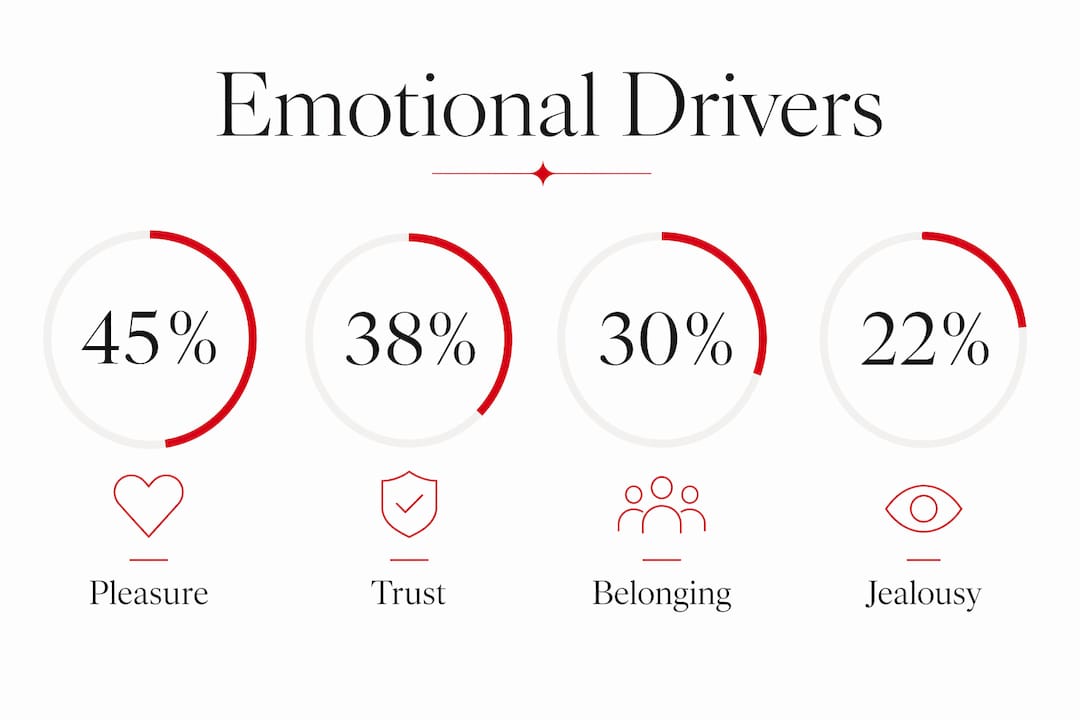
The instinct in luxury marketing is to focus on aspirational warmth: the feeling of being welcomed into an exclusive world. That instinct is partially correct, but incomplete. Research confirms that status and competence-related emotions, including brand jealousy, are equally powerful drivers of attachment in premium contexts.
The 2026 BMC Psychology study on luxury apparel found that brand jealousy increases emotional attachment, which in turn raises customers’ willingness to pay premium prices and promotes positive word-of-mouth. This matters because jealousy is not a negative signal to suppress. It is a status signal that confirms desirability. When a customer sees someone else carrying a limited-edition piece and feels that pull, the brand has done its job.
Luxury marketers should work with two distinct emotional registers:
- Warm emotions: belonging, nostalgia, pride of ownership, and personal identity reinforcement. These are the emotions Hermès activates through its artisan heritage narrative.
- Status and competence emotions: admiration, envy, and brand jealousy. These are the emotions that make a Rolex visible on a wrist feel like a statement rather than a timepiece.
The critical insight from the BMC Psychology research is that brands should not sanitize their emotional mix. Attempting to strip jealousy or status signaling from luxury messaging in favor of purely warm, inclusive tones dilutes the psychological mechanism that makes luxury desirable in the first place.
Pro Tip: Map the actual emotional ecosystem your customers report experiencing, not the emotions you assume they feel. Survey language, social listening, and post-purchase interviews will surface status emotions that your brand team may be underutilizing.
How do visual design and storytelling create emotional connections?
Visual identity is not decoration. It is the first emotional signal your brand transmits, and it operates faster than language. Up to 90% of a customer’s first impression is shaped by color and visual design alone, with that judgment forming within 90 seconds of exposure. For luxury brands, this means every color palette decision, typeface choice, and packaging material carries psychological weight.

The comparison below illustrates how two different approaches to visual and narrative branding produce different emotional outcomes:
| Approach | Visual and narrative method | Emotional outcome |
|---|---|---|
| Transactional branding | Product-focused imagery, feature-led copy, seasonal campaigns | Short-term purchase intent, low attachment |
| Emotional branding | Consistent visual identity, values-led storytelling, heritage narratives | Long-term loyalty, price premium acceptance, advocacy |
Storytelling connects brand values with consumer aspirations, and in luxury this connection must run through the entire customer journey, not just advertising campaigns. Louis Vuitton’s travel heritage narrative, for example, appears in store architecture, packaging, digital content, and sales associate training. The story is not a campaign. It is the operating logic of the brand.
Authenticity is the variable that determines whether storytelling builds trust or erodes it. Customers in the luxury sector are sophisticated. They detect inconsistency between brand narrative and actual experience immediately. A brand that tells a story of artisan craftsmanship and then delivers poor after-sales service has broken the emotional contract. For a deeper look at how luxury storytelling builds prestige, the mechanics of narrative consistency are worth studying in detail.
Pro Tip: Audit your brand’s visual and narrative touchpoints as a single system. Identify where the emotional story breaks down, whether in packaging, digital UX, or in-store experience, and treat those gaps as high-priority fixes rather than minor inconsistencies.
What is the role of emotional engagement versus satisfaction in driving luxury loyalty?
Satisfaction is a threshold, not a destination. A customer who is satisfied with a purchase has received what they expected. A customer who is emotionally engaged has received something that reinforces their identity, their status, or their sense of pleasure and control. These are categorically different psychological states, and they produce categorically different loyalty behaviors.
A 2026 Springer Nature study using the EXQ and PAD framework examined emotional drivers of satisfaction and loyalty in banking. The findings are directly applicable to luxury brand management. The study confirmed that pleasure and dominance mediate the satisfaction-loyalty link effectively, while arousal had limited effect. This means that what sustains loyalty is not excitement or stimulation per se. It is the feeling of pleasure combined with a sense of personal agency and control.
The data from that study is instructive for luxury brand strategy:
| Emotional dimension | Effect on loyalty | Implication for luxury brands |
|---|---|---|
| Pleasure | Strong positive mediator | Prioritize sensory and experiential delight at every touchpoint |
| Dominance (sense of control) | Strong positive mediator | Give customers agency: personalization, exclusivity, access |
| Arousal | Limited effect | Do not rely on novelty or excitement as the primary loyalty driver |
Satisfaction alone is insufficient to build deep attachment. A customer who rates their experience 9 out of 10 but feels no emotional resonance will defect the moment a competitor offers a marginally better product or price. The luxury brands that retain customers across decades, think Cartier or Bottega Veneta, do so because they consistently deliver pleasurable and empowering experiences that go well beyond functional satisfaction.
How to implement emotional branding strategies throughout the luxury customer journey?
Emotional branding in luxury must function as an operating system, not a campaign calendar. Consistent emotional arc from discovery through post-purchase reinforces identity signals at every stage and prevents the bond from breaking at vulnerable moments like service recovery or product issues.
Here is a practical framework for operationalizing emotional branding across the full customer journey:
-
Audit every touchpoint for emotional signal. Map the customer journey from first digital impression through unboxing, first use, and after-sales contact. Identify which touchpoints currently deliver emotional resonance and which are functionally neutral or negative.
-
Assign an emotional objective to each stage. Discovery should trigger aspiration and desire. Purchase should deliver pride and belonging. Post-purchase should reinforce identity and exclusivity. Service recovery should restore trust and demonstrate that the brand values the relationship above the transaction.
-
Align visual, verbal, and experiential cues. The emotional story must be consistent across Instagram content, store environment, packaging, email communication, and sales associate language. Inconsistency at any point breaks the psychological contract.
-
Collect and use customer emotional feedback internally. Customer stories, unsolicited testimonials, and qualitative feedback reveal which emotional signals are landing and which are missing. Share this data across marketing, product, and service teams so that emotional brand identity is not siloed in the marketing department.
-
Measure emotional engagement, not just satisfaction scores. Net Promoter Score and CSAT measure satisfaction thresholds. To track emotional attachment, use qualitative sentiment analysis, brand association studies, and willingness-to-pay research at regular intervals.
For a detailed breakdown of how to apply these principles in practice, the emotional branding guide for luxury covers touchpoint mapping and engagement measurement in depth.
The luxury brand identity framework from visual identity specialists also provides useful structure for aligning visual and emotional cues across brand systems.
Key takeaways
Creating emotional brand connections in luxury requires engineering specific psychological states, including pleasure, dominance, and even jealousy, across every customer touchpoint, not just in advertising.
| Point | Details |
|---|---|
| Emotional attachment vs. satisfaction | Attachment drives premium pricing and advocacy; satisfaction alone does not sustain loyalty. |
| Jealousy as a strategic asset | Brand jealousy increases attachment and willingness to pay premiums in luxury apparel contexts. |
| Visual design carries emotional weight | Up to 90% of first impressions are shaped by color and visual identity, making design a primary emotional tool. |
| Pleasure and dominance drive loyalty | Emotional engagement through pleasurable, empowering experiences mediates the satisfaction-to-loyalty link. |
| End-to-end emotional consistency | Emotional branding must function as a system across discovery, purchase, and post-purchase, not as isolated campaigns. |
Why most luxury brands underinvest in emotional complexity
The most common mistake I see in luxury brand management is treating emotional branding as a creative brief rather than a strategic system. A campaign gets produced, it performs well, and the team moves on. Six months later, the emotional signal has faded because nothing in the service experience, the packaging update, or the digital touchpoints was aligned with the original emotional intent.
The second mistake is emotional sanitization. Brands become nervous about complex emotions like jealousy or exclusion, so they soften their messaging toward generic warmth and aspiration. The result is a brand that feels pleasant but not magnetic. Luxury desirability depends on a degree of inaccessibility and status tension. Removing that tension in the name of inclusivity is a strategic error that costs brands their pricing power over time.
What actually works, in my experience, is treating emotional brand identity as an internal alignment problem before it becomes an external communication problem. When your product team, your retail team, and your digital team all understand the specific emotional states the brand is designed to create, consistency follows naturally. When emotional branding lives only in the marketing department, it breaks down at every handoff.
The luxury branding principles that sustain long-term emotional resonance are not complicated. They require discipline, internal alignment, and the willingness to work with the full emotional complexity of your audience rather than a curated subset of it.
— Corrado
How Corradomanenti can accelerate your emotional branding strategy
Corradomanenti works with luxury fashion and lifestyle brands to build emotionally resonant brand systems grounded in consumer psychology. The approach goes beyond creative direction to address the psychological mechanisms that drive attachment, premium pricing acceptance, and long-term advocacy.
If you are ready to move from satisfaction-focused metrics to genuine emotional engagement, the luxury brand growth tactics resource covers the specific strategies Corrado applies with clients in the fashion and luxury sectors. For a deeper foundation in narrative-driven brand building, the effective storytelling guide for luxury provides the frameworks that make emotional branding repeatable and measurable across your entire customer journey.
FAQ
What is emotional brand connection in luxury marketing?
Emotional brand connection is a measurable psychological attachment that goes beyond customer satisfaction to create lasting loyalty, advocacy, and willingness to pay premium prices. It is distinct from satisfaction and can be strategically engineered through consistent emotional signals across all brand touchpoints.
Why does brand jealousy matter for luxury brands?
Brand jealousy is a status signal that confirms desirability. The 2026 BMC Psychology study found that jealousy increases emotional attachment, which in turn raises customers’ willingness to pay premium prices and drives positive word-of-mouth in luxury apparel markets.
How does emotional engagement differ from customer satisfaction?
Satisfaction means a customer received what they expected. Emotional engagement means the experience reinforced their identity, sense of pleasure, or personal agency. Research using the PAD framework confirms that pleasure and dominance, not satisfaction scores, are the primary mediators of long-term loyalty.
What role does visual design play in emotional branding?
Visual design is the first emotional signal a brand transmits. Up to 90% of a customer’s first impression is shaped by color and visual identity within 90 seconds, making design decisions a primary driver of emotional response before any narrative or service interaction occurs.
How often should luxury brands audit their emotional branding?
Luxury brands should conduct a full emotional touchpoint audit at least annually and after any significant product, service, or communication change. Emotional consistency breaks down most often at operational handoffs, such as between marketing and retail or digital and in-store, so cross-functional reviews are more effective than marketing-only assessments.