TL;DR:
- Psychology fundamentally influences how consumers adopt fashion trends, shaping behavior through mechanisms like social proof and identity signaling. The 20-year cycle of trend recurrence results from optimal distinctiveness, balancing novelty with familiarity across generations. Recognizing enclothed cognition and inclusive design’s effects can help brands foster stronger consumer trust and mental well-being.
Fashion psychology is defined as the study of how cognitive, emotional, and social processes shape what people wear and why trends spread, stall, or return. The role of psychology in fashion trends operates through mechanisms most consumers never consciously recognize: enclothed cognition, optimal distinctiveness, social proof, and identity signaling. These aren’t abstract academic concepts. They are the actual forces driving purchase decisions at Zara, fueling the Y2K revival, and explaining why a power suit changes how its wearer thinks. For fashion professionals, understanding these mechanisms is the difference between chasing trends and predicting them.
How psychological theories explain consumer behavior in fashion
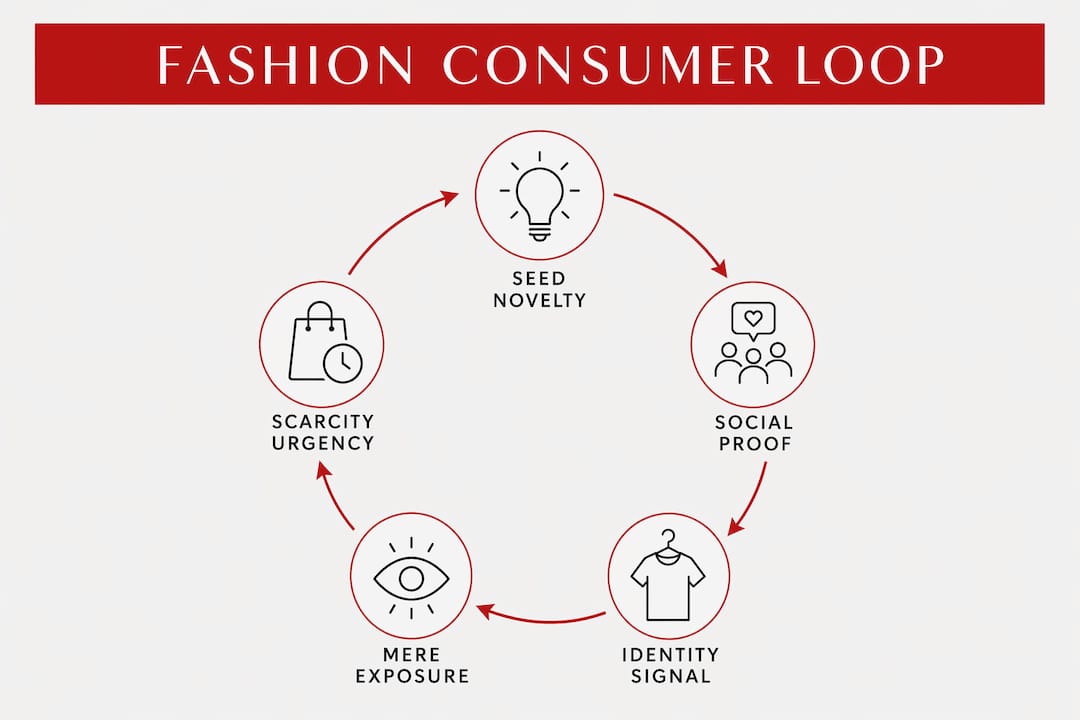
Consumer behavior in fashion follows a predictable feedback loop involving four core psychological mechanisms: the mere-exposure effect, social proof, identity signaling, and perceived scarcity. Each one operates at a different stage of trend adoption, and together they explain why certain styles go viral while others disappear after one season.
Social proof is the most visible driver. When consumers see a style worn repeatedly across Instagram, TikTok, or on peers they admire, the brain interprets that frequency as evidence of quality and social acceptability. This is why influencer seeding campaigns work so reliably. The style doesn’t need to be objectively superior. It needs to appear popular first.
Identity signaling operates at a deeper level. Clothing communicates personality, tribal affiliation, and social status without a single word spoken. Streetwear brands like Supreme built entire empires on this principle, where wearing the logo signals membership in a specific cultural group. Research confirms that congruent appearance signals build consumer trust, while mismatched signals create psychological dissonance that erodes brand credibility. For luxury brands, this means every element of styling must align with the identity the brand promises.
The mere-exposure effect explains why trends feel comfortable rather than jarring after repeated exposure. A silhouette that looks strange in week one feels familiar and desirable by week six. This is the psychological engine behind trend normalization, and it’s why fashion editors introduce avant-garde pieces months before they reach mass retail.
Perceived scarcity closes the loop. Limited drops from brands like Nike or Hermès trigger urgency and impulsive buying behavior by activating loss aversion, a well-documented cognitive bias. Scarcity signals that a product is desirable enough that others want it, reinforcing social proof simultaneously.
Pro Tip: When launching a new collection, sequence your marketing to mirror the psychological loop: seed novelty first, build social proof through micro-influencers, then introduce limited availability to drive conversion. This order matters.
What is the 20-year fashion cycle and why does it keep repeating?
Mathematical models confirm a roughly 20-year cycle in trend recurrence, and the explanation is psychological rather than arbitrary. The mechanism is optimal distinctiveness theory, developed by social psychologist Marilynn Brewer, which holds that humans simultaneously want to belong to a group and stand out from it. A trend satisfies both needs when it feels novel enough to signal individuality but familiar enough to feel socially safe.
The 20-year gap is the precise window in which a style becomes simultaneously nostalgic for one generation and genuinely new for the next. Millennials who wore Y2K fashion as teenagers now hold purchasing power, but Gen Z encounters low-rise jeans and butterfly clips as fresh discoveries. The 20-year trend cycle is not nostalgia alone. It is optimal distinctiveness operating across generational cohorts.
| Psychological Principle | Fashion Application | Example |
|---|---|---|
| Optimal distinctiveness | Trend must balance novelty and familiarity | Y2K revival appealing to Gen Z |
| Mere-exposure effect | Repeated visibility normalizes new styles | Oversized blazers in editorial before retail |
| Generational novelty gap | 20-year cycle creates fresh discovery for new cohort | Low-rise jeans returning in 2023 |
| Social proof acceleration | Social media speeds awareness without disrupting the core cycle | TikTok trend visibility compressed to weeks |
Social media compresses the awareness phase of this cycle dramatically. A trend that once took two years to move from runway to street now achieves mass visibility in weeks. But the underlying psychological cycle remains intact because the desire for optimal distinctiveness is hardwired, not platform-dependent.
How does enclothed cognition change wearer behavior?
Enclothed cognition is the term psychologists Adam and Galinsky coined to describe how clothing alters the wearer’s cognitive processes through the symbolic meaning attached to a garment. The physical act of wearing is not sufficient alone. The meaning the wearer assigns to the garment activates the psychological effect.
The foundational study is striking: participants who wore a lab coat described as a doctor’s coat performed significantly better on attention tasks than those wearing the identical coat described as a painter’s smock. Same garment, different meaning, measurably different cognition. This finding has direct implications for fashion branding.
Wearing formal attire activates achievement-oriented self-construals, meaning people who dress formally describe themselves in more independent and goal-directed terms. This is the psychological mechanism behind power dressing, and it explains why corporate dress codes persist despite remote work culture pushing casual norms.
Fashion brands that understand enclothed cognition build it into their positioning deliberately:
- Lululemon names activewear products with aspirational language (“Swiftly,” “Align”) to prime performance mindsets before the workout begins.
- Luxury tailors like Brioni and Kiton market their suits explicitly around the confidence and authority the wearer will project and feel.
- Athleisure brands use fabric technology claims not just for functional differentiation but to reinforce the psychological permission to feel athletic.
Pro Tip: When writing product descriptions or campaign copy, name the psychological state the garment activates, not just its physical properties. “Structured shoulders for boardroom authority” outperforms “tailored fit” because it tells the consumer what they will become, not just what they will wear.
How does fashion shape consumer identity, social signaling, and mental well-being?
Clothing is the most immediate non-verbal communication system humans use. The brain makes 11 distinct judgments about a stranger within the first 7 seconds of an encounter, with clothing serving as the primary data source for those assessments. This means fashion choices carry social consequences that extend far beyond personal aesthetics.
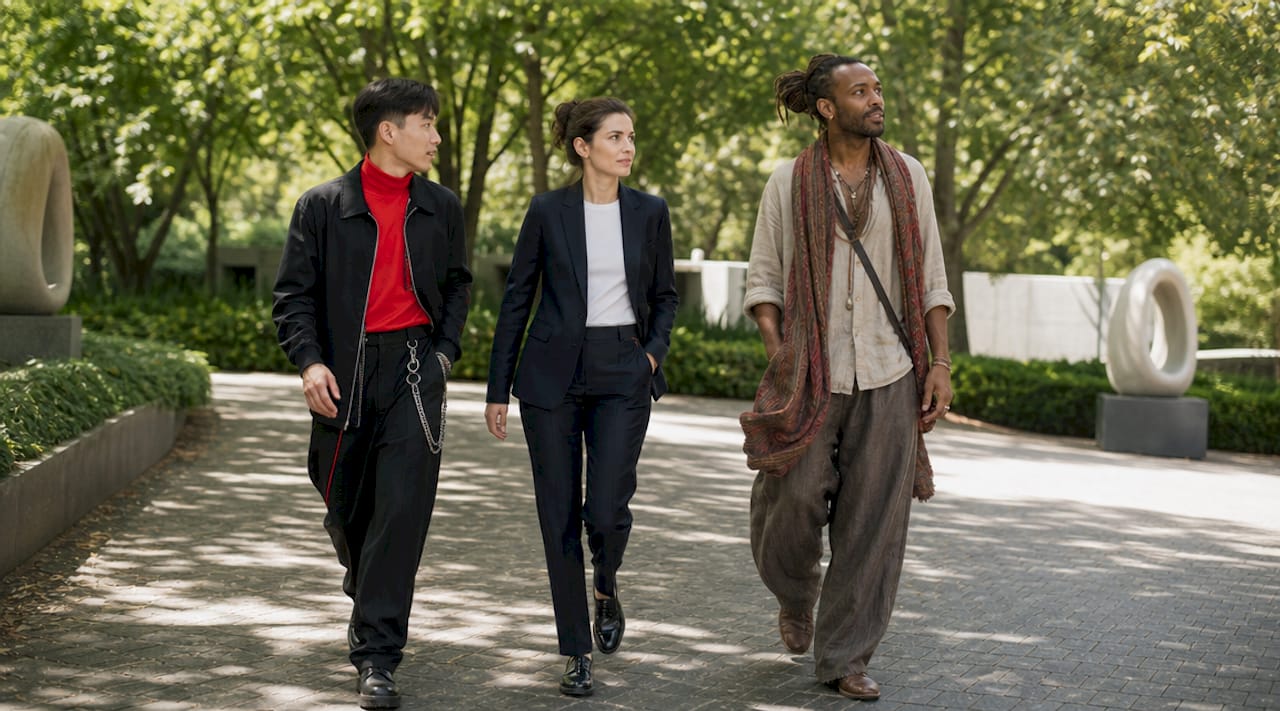
The psychological influence on style extends inward as well as outward. Clothing satisfaction accounts for 19% of the variance in mental well-being scores for middle-aged women, linked specifically to reduced social avoidance. That figure is not trivial. It positions fashion as a legitimate mental health variable, not a superficial concern.
The social psychology in clothing becomes particularly consequential when brands fail on inclusivity. Lack of inclusive sizing creates psychological barriers that prevent consumers from expressing identity and building confidence through dress. When a consumer cannot find clothing that fits, the message received is one of exclusion, and the psychological cost is real. Brands that ignore psychology force consumers to choose between their authentic self and the industry’s narrow ideal, which is a brand relationship that cannot sustain loyalty.
| Fashion Context | Psychological Impact | Brand Implication |
|---|---|---|
| Well-fitting, inclusive clothing | Reduced social avoidance, higher well-being | Expand size ranges to capture loyalty |
| Exclusive or ill-fitting options | Identity suppression, confidence erosion | Inclusivity gaps create lasting brand damage |
| Aspirational brand storytelling | Activates identity alignment and desire | Congruent messaging builds trust faster |
| Poor congruence signals | Psychological dissonance, reduced trust | Mismatched brand elements undermine premium positioning |
The psychology of color in fashion adds another layer. Color choices in clothing trigger automatic emotional and social associations. Black signals authority and sophistication. Red activates arousal and urgency. Brands that apply color psychology strategically in their collections and campaigns create emotional resonance before a consumer reads a single word of copy.
Key takeaways
Fashion psychology drives every stage of the consumer journey, from the first impression a garment creates to the long-term loyalty a brand earns through identity alignment and inclusive design.
| Point | Details |
|---|---|
| Enclothed cognition is real | The symbolic meaning of clothing measurably changes wearer cognition, confidence, and performance. |
| The 20-year cycle is psychological | Trend recurrence follows optimal distinctiveness theory, not random nostalgia or industry scheduling. |
| Social proof drives adoption | Perceived popularity triggers trend adoption faster than any product quality claim. |
| Clothing affects mental well-being | Clothing satisfaction explains 19% of well-being variance, making inclusivity a psychological priority. |
| Congruence builds brand trust | Aligned appearance signals create consumer trust; mismatched signals erode premium positioning. |
Why fashion professionals can’t afford to ignore psychology
I’ve spent years working at the intersection of psychology and luxury fashion marketing, and the pattern I see most often is this: brands invest heavily in aesthetics and almost nothing in understanding why their consumer responds the way they do. The result is beautiful campaigns that don’t convert, and product launches that miss the emotional mark entirely.
The most common mistake I encounter is treating psychology as a soft add-on rather than the structural foundation of brand strategy. When I work with a luxury fashion client, the first question I ask is not “What does your brand look like?” It’s “What psychological state does your brand activate in the consumer, and is every touchpoint consistent with that state?” That question changes everything.
Inclusivity is where I see the largest gap between what brands say and what they do. Brands talk about diversity in campaigns while maintaining size ranges that exclude the majority of real consumers. That contradiction is not just an ethical failure. It is a psychological one. Consumers detect incongruence instinctively, and the trust damage is disproportionate to the offense. Integrating mental health professionals and psychologists into design and marketing teams, as some forward-thinking brands are beginning to do, is the direction the industry must move.
My recommendation for any fashion professional reading this: treat psychological research as a primary source, not a secondary reference. The psychology in branding literature is rich, specific, and directly applicable to collection positioning, campaign sequencing, and consumer retention strategy. The brands that read it and act on it will outperform those that rely on intuition alone.
— Corrado
Work with Corradomanenti to apply psychology to your fashion brand
Corradomanenti specializes in exactly this intersection: applying psychological principles to build fashion and luxury brands that connect with consumers at a cognitive and emotional level. If you’re a fashion professional looking to move beyond surface-level trend analysis and understand the behavioral drivers behind your consumer’s choices, the resources and consulting frameworks at Corradomanenti are built for that purpose. Explore the luxury fashion brand growth tactics that integrate buyer psychology with premium brand positioning, or go deeper with the psychology in luxury branding guide for 2026 strategies that convert.
FAQ
What is the role of psychology in fashion trends?
Psychology drives fashion trends through mechanisms including social proof, identity signaling, enclothed cognition, and optimal distinctiveness. These cognitive and social processes determine which styles consumers adopt, how quickly trends spread, and why certain fashions return on a predictable cycle.
How does enclothed cognition affect fashion choices?
Enclothed cognition describes how the symbolic meaning of a garment alters the wearer’s cognitive state and behavior. Studies show that wearing a coat described as a doctor’s coat improves attention performance compared to the identical coat described as a painter’s smock.
Why do fashion trends repeat every 20 years?
Mathematical models confirm a 20-year trend cycle driven by optimal distinctiveness theory. The gap is long enough for a style to feel genuinely novel to a new generation while remaining nostalgic for the generation that wore it originally.
How does clothing affect mental well-being?
Clothing satisfaction accounts for approximately 19% of the variance in mental well-being scores for middle-aged women, with well-fitting, inclusive fashion linked directly to reduced social avoidance and higher confidence.
Why does inclusive sizing matter psychologically?
Lack of inclusive sizing creates psychological barriers that prevent consumers from expressing identity through clothing. When consumers cannot find clothes that fit, the experience signals exclusion, suppressing confidence and eroding brand loyalty over time.