


TL;DR:
- Niche market targeting directs marketing efforts toward narrowly defined segments with unmet needs, enabling premium pricing and stronger authority. It reduces competition, builds customer loyalty, and accelerates trust within the segment by delivering tailored messaging and experiences. Effective validation, community building, and deliberate expansion are essential for sustained growth and competitive advantage.
Niche market targeting is the practice of directing all marketing efforts toward a narrowly defined audience segment whose specific needs remain unmet by broader market offerings. Unlike general market strategies that cast wide nets and accept low conversion rates as the cost of reach, niche targeting concentrates resources on a precise slice of the market where your brand can become the recognized authority. According to The Strategy Institute’s 2025 assessment, niche strategies enable premium pricing through quality and specificity rather than volume, sometimes doubling what broad market competitors can charge. The approach combines demographic, psychographic, and firmographic analysis to build messaging so specific it feels personal to every reader who encounters it.

What is niche market targeting and why does it outperform broad strategies?
Niche market targeting is defined as the deliberate concentration of marketing resources on a well-specified consumer segment, identified by shared characteristics that make them distinctly receptive to a tailored offer. The contrast with mass marketing is not just philosophical. It is measurable. Broad campaigns distribute budget across audiences with wildly different motivations, which dilutes both message relevance and conversion probability. Niche campaigns speak directly to one type of person with one type of problem, which is why targeted messaging improves ROI and engagement rates far beyond what generalist approaches achieve.
The efficiency argument alone justifies the shift. When you define your segment precisely, every dollar of ad spend, every piece of content, and every sales conversation targets someone who already fits your ideal customer profile. Waste drops. Conversion climbs. The brand begins to accumulate authority within the segment because it consistently shows up with relevant answers to relevant problems.
What makes this particularly powerful in 2026 is the fragmentation of consumer attention across platforms. Broad messaging gets ignored because consumers have trained themselves to filter out anything that does not feel directly relevant. Niche messaging cuts through precisely because it does feel relevant. It reads like it was written for the reader specifically, because it was.
What are the key benefits of niche targeting for your business?
The benefits of niche targeting extend well beyond marketing efficiency, though that alone is compelling. Here is where the real competitive advantages accumulate:
- Premium pricing power. Specialized solutions command higher prices. Consumers pay more when they believe a product or service was built specifically for their situation. Niche strategies enable premium pricing that broad market competitors cannot match without abandoning their positioning.
- Reduced competitive pressure. As of mid-2026, niche marketing combats saturation by targeting less contested segments where large generalist brands rarely compete effectively. You are not fighting Procter & Gamble. You are owning a corner of the market they do not care about yet.
- Stronger customer loyalty. Thrive Agency reports that 45% of niche website creators report more loyal readership than their broad-market counterparts. Loyalty in a niche is not accidental. It comes from customers who feel genuinely understood, which makes switching to a competitor feel like a step backward.
- Faster authority building. A brand that dominates a specific segment earns trust faster than one trying to be everything to everyone. Customers in tight communities talk to each other, and a strong reputation spreads quickly within a niche.
- Higher lifetime customer value. Quality audience relationships drive sustainable growth because loyal niche customers buy repeatedly, refer others, and resist competitor offers. The math favors depth over breadth.
Pro Tip: Before calculating your niche’s revenue potential, estimate customer lifetime value rather than just market size. A niche of 10,000 highly loyal buyers often outperforms a broad market of 1 million indifferent ones.
Consider how a luxury skincare brand targeting women over 50 with hormonally sensitive skin outperforms a general anti-aging line. The messaging is specific, the product formulation is specific, and the customer feels seen. That specificity is the product, not just the marketing.
How to identify and define a profitable niche market segment
Finding a viable niche is not guesswork. It is a structured process that combines data analysis with genuine customer empathy. The three core dimensions you must analyze are demographic (age, income, location), psychographic (values, lifestyle, beliefs), and firmographic (industry, company size, role) characteristics. Research confirms that targeting all three dimensions increases messaging precision and customer loyalty simultaneously.
Follow this sequence to validate a niche before committing budget:
- Start with a problem, not a product. Identify a specific pain point that existing solutions address poorly or not at all. Marketing translator Hirodai Iguchi argues that responding to small wants transforms a general service into a specialized must-have. The smaller and more specific the want, the less competition you face.
- Layer your filters. Begin with a demographic group, then narrow by psychographic profile. A 35-year-old professional woman is a demographic. A 35-year-old professional woman who prioritizes sustainable fashion and distrusts fast fashion brands is a niche.
- Validate with search data. Use Google Trends to confirm that your niche has consistent search interest. Practitioners warn that niching too narrowly without validating demand creates a segment too small to sustain a business.
- Analyze competitor gaps. Study what the top three competitors in your broader category are not addressing. Those gaps are your entry points.
- Test before scaling. Run a small paid campaign or publish targeted content before committing to full product development. Real engagement data beats assumptions every time.
| Evaluation attribute | What to measure |
|---|---|
| Demographic specificity | Age, income bracket, geographic concentration |
| Psychographic depth | Values, lifestyle patterns, unmet emotional needs |
| Search demand | Monthly search volume, trend direction over 12 months |
| Competitive density | Number of direct competitors, quality of their niche focus |
| Monetization potential | Willingness to pay, average order value in adjacent markets |
Pro Tip: Use Reddit communities and niche Facebook groups as free research tools. The language people use to describe their problems is the exact language your copy should mirror.
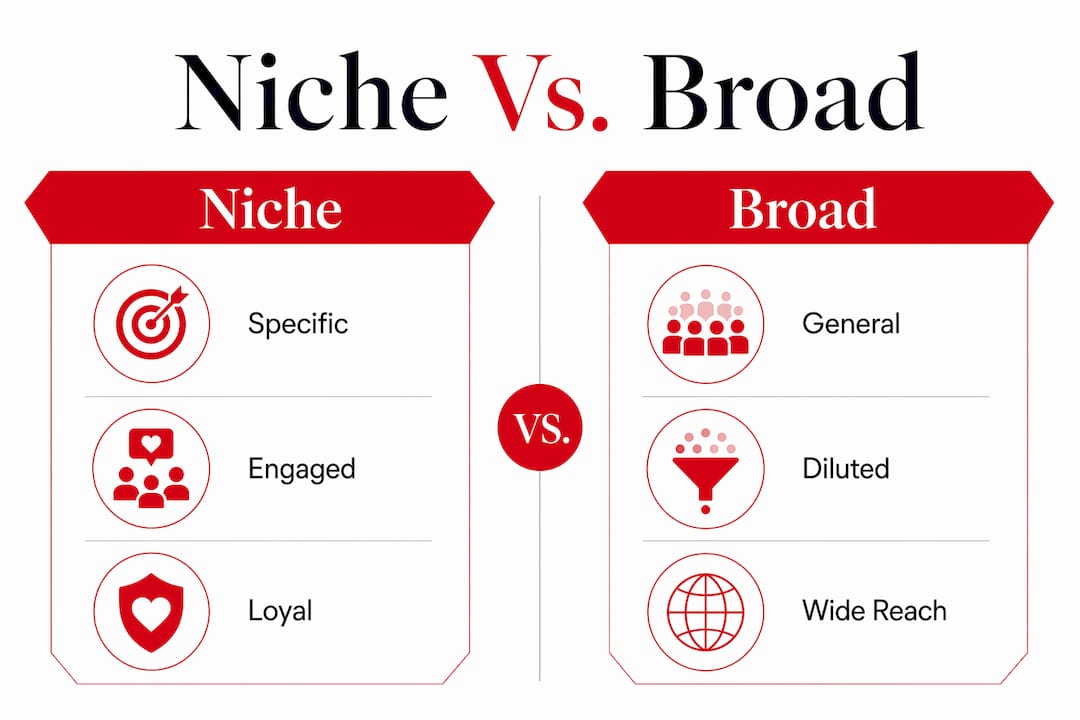
Niche marketing strategies that actually convert
Knowing your niche is only half the work. Executing a niche marketing strategy that converts requires deliberate choices about messaging, channels, and community building.
Hyper-specific messaging is the foundation. Generic value propositions fail in niche markets because the audience has already heard them from larger brands. Your copy must name the exact problem, speak to the exact context, and offer a solution that feels purpose-built. If you are targeting a niche audience of independent luxury boutique owners, your messaging should reference their specific challenges: inventory risk, brand storytelling, and the pressure of competing with department stores.
Channel selection follows from audience behavior, not from what is popular. Niche audiences often concentrate on specific platforms, publications, or communities. A brand targeting professional sommeliers does not need TikTok reach. It needs a presence in trade publications, industry events, and LinkedIn groups where sommeliers actually gather.
The comparison below clarifies how niche and broad strategies diverge in practice:
| Strategic dimension | Niche market approach | Broad market approach |
|---|---|---|
| Messaging | Addresses one specific pain point | Covers multiple general benefits |
| Pricing | Premium, justified by specialization | Competitive, driven by volume |
| Channel focus | Concentrated in segment-specific spaces | Distributed across mass channels |
| Customer relationship | Deep, loyalty-driven, community-based | Transactional, high churn |
| Authority building | Fast within segment | Slow and diluted across categories |
Community building is the long-term multiplier. Brands that create spaces where niche customers connect with each other, whether through events, private groups, or curated content, generate word-of-mouth that no paid campaign can replicate. Understanding customer loyalty in luxury reveals that niche customers who feel part of a community become advocates, not just buyers.
Common pitfalls in niche targeting and how to avoid them
Even well-intentioned niche strategies fail when marketers make predictable mistakes. Recognizing these traps early saves significant budget and time.
- Relying only on demographics. GoDaddy’s expert guidance confirms that deep psychographic understanding drives stronger niche resonance than demographic filters alone. Knowing your customer is 45 years old and earns $150,000 tells you almost nothing about what they fear, value, or want to become.
- Niching too narrowly. A niche must be specific enough to differentiate but large enough to sustain revenue. If your total addressable market is 2,000 people globally, the economics rarely work unless your average contract value is exceptionally high.
- Ignoring saturation signals. Niches that were underserved two years ago may now be crowded. Monitor competitor activity and search trend data quarterly to catch saturation before it erodes your margins.
- Treating the niche as permanent. HubSpot notes that successful niche expansion into adjacent segments supports sustainable scaling without damaging brand identity. The goal is not to stay small. It is to dominate a segment and then grow deliberately from that position of strength.
Pro Tip: Set a quarterly review of your niche’s competitive density using tools like SEMrush or Ahrefs. If three or more well-funded competitors have entered your segment in the past six months, it is time to either deepen your differentiation or identify an adjacent niche to move toward.
The most common failure mode is not picking the wrong niche. It is executing a niche strategy with broad-market habits. Specific audiences require specific commitments. Half-measures produce half-results.
Key takeaways
Niche market targeting succeeds when specificity, validation, and deep customer understanding work together to create a brand that a defined segment cannot imagine replacing.
| Point | Details |
|---|---|
| Define niche with three filters | Combine demographic, psychographic, and firmographic data for precise segment identification. |
| Validate before investing | Use Google Trends and competitor analysis to confirm sustainable demand before committing resources. |
| Price for specialization | Niche authority justifies premium pricing that broad market competitors cannot credibly match. |
| Build community, not just campaigns | Loyal niche customers who connect with each other generate compounding word-of-mouth growth. |
| Plan for niche evolution | Successful niches expand into adjacent segments over time; build that trajectory into your strategy from day one. |
Why niche targeting is the sharpest tool in the luxury marketer’s kit
I have worked with fashion and luxury brands long enough to know that the instinct to go broad is almost always wrong. The fear of leaving money on the table by narrowing your focus is understandable. But in practice, the brands that try to speak to everyone end up resonating with no one.
What I find most underappreciated about niche targeting is the psychological dimension. When a brand speaks directly to a specific type of person, that person does not just buy the product. They adopt the brand as part of their identity. That is not a marketing outcome. That is a psychological bond, and it is extraordinarily difficult for competitors to break. In luxury markets, where the emotional and symbolic value of a purchase often outweighs its functional value, this bond is the entire business model.
I also push back on the idea that niches are limiting. The brands I have seen grow most aggressively started with a tight niche, built unassailable authority there, and then expanded deliberately into adjacent segments. They did not dilute their positioning. They extended it. Bottega Veneta did not try to compete with Louis Vuitton on logo recognition. It owned quiet luxury before the term existed, and then expanded from that position of strength.
The practical lesson: pick a segment where you can be the best answer in the room, not just a good answer in a crowded one. Depth of resonance beats breadth of reach every time.
— Corrado
How Corradomanenti helps brands win through niche positioning
Corradomanenti works with fashion, luxury, and lifestyle brands that need more than generic marketing advice. The methodology combines consumer psychology with precision segmentation to identify the exact niche where a brand can build authority and command premium positioning. Whether you are defining your segment for the first time or refining a strategy that has plateaued, the work starts with understanding why your best customers choose you, not just who they are. Explore the fashion brand growth tactics that Corradomanenti applies to luxury market success, or review the buyer behavior analysis framework used to identify and engage high-value niche segments with precision.
FAQ
What is niche market targeting in simple terms?
Niche market targeting is the practice of focusing all marketing efforts on a specific, well-defined consumer segment whose needs are not fully met by existing broad-market offerings. The goal is to become the preferred, authoritative solution for that segment rather than a generic option for everyone.
How is niche marketing different from mass marketing?
Mass marketing distributes a single message across the widest possible audience, accepting low relevance as a trade-off for reach. Niche marketing concentrates resources on a narrow segment with a highly specific message, producing higher conversion rates and stronger customer loyalty at lower waste.
What are the main benefits of niche targeting?
The primary benefits include premium pricing power, reduced competitive pressure, higher customer loyalty, and faster authority building within the segment. Thrive Agency reports that niche-focused brands consistently achieve higher engagement and retention than their broad-market counterparts.
How do you validate a niche market before investing?
Validate a niche by checking search volume data through Google Trends, analyzing competitor gaps in the segment, and running small-scale content or paid tests before committing full budget. Coursera’s research confirms that niche viability requires confirmed demand across multiple data sources, not just intuition.
Can a niche strategy scale into a larger market?
Yes. HubSpot identifies niche expansion into adjacent segments, sometimes called “niching up,” as a proven path to sustainable growth. The key is maintaining the expert positioning that made the original niche successful while extending into related areas where that authority still applies.