

TL;DR:
- Early trend adoption offers luxury brands a significant competitive edge by shaping consumer perception and building proprietary data early.
- The acceleration phase provides the highest return, making timely activation crucial before trends peak or decline.
Early trend adoption is the practice of engaging with emerging consumer, cultural, or technological shifts during their acceleration phase to secure lasting competitive advantages. For luxury brand strategists, this is not a peripheral tactic. It is the mechanism that separates brands that define culture from those that merely react to it. Research across multiple industries confirms that early adopters represent 13.5% of any market population, yet they capture a disproportionate share of positioning power, margin premium, and consumer loyalty. The diffusion of innovations framework, developed by Everett Rogers, explains why: each adopter category carries distinct motivations, and the window for maximum impact closes faster than most brand teams anticipate.
Why early trend adoption matters for competitive advantage
The competitive benefits of moving early are not linear. They compound. The first brand to reach a critical adoption threshold in a new trend does not simply gain a head start. It builds proprietary data, organizational capability, and consumer perception that late movers cannot replicate by spending more money later.
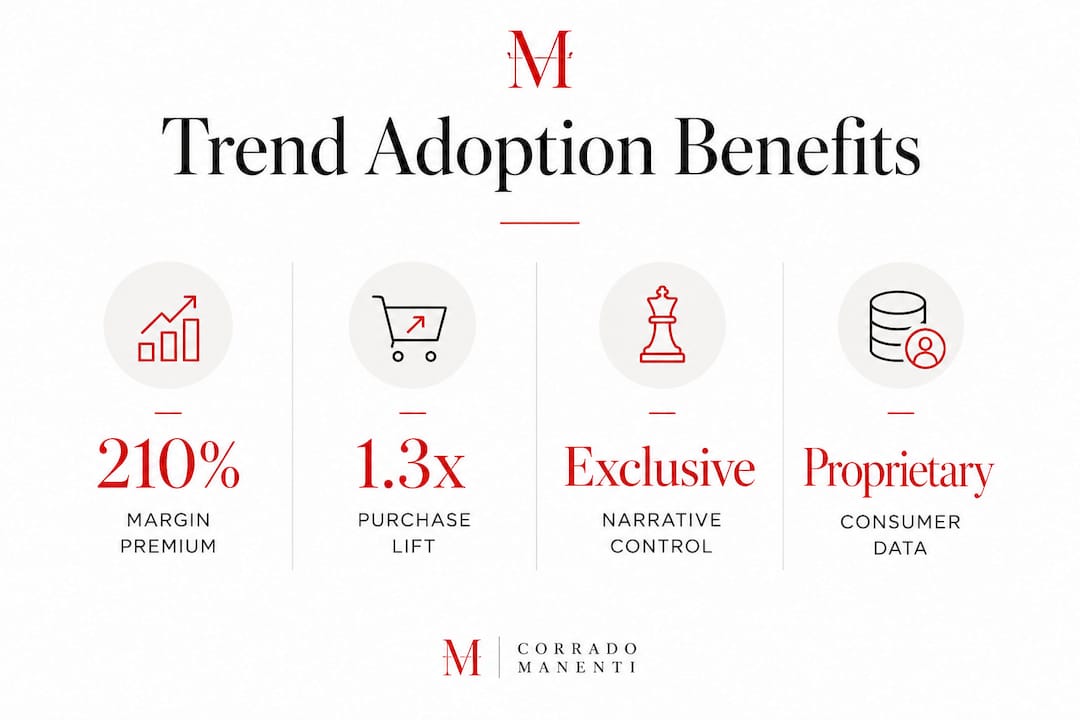
Simulations across industries show that the first firm to 50% adoption of a new technology or trend captures a 210% cumulative margin premium over the average competitor. That gap does not shrink over time. It widens. Competitive separation becomes entrenched within roughly three months of the tipping point, meaning the window to act is narrow and unforgiving.
The data from AI adoption tells the same story with numbers that luxury marketers should not ignore. Organizations that adopt early see 30% efficiency gains, 25% faster decision-making, and up to 122% increased cash flow. Late adopters, by contrast, absorb losses of up to 23%. These figures come from technology adoption, but the underlying mechanism applies to any trend: early movers build feedback loops that improve their position continuously, while late movers pay premium costs to enter a market already shaped by someone else.
“Waiting for proof often guarantees arrival too late to compete effectively. Competitive tipping points are reached in a median of three months. By the time the evidence is undeniable, the advantage is already gone.”
For luxury brands, this dynamic carries extra weight. Exclusivity and cultural authority are the product. A brand that arrives second to a cultural moment does not share the spotlight. It signals that it follows rather than leads. That perception is extraordinarily difficult to reverse.
The early adopter advantages in luxury are also structural. Brands that move first accumulate consumer behavioral data from the trend’s earliest, most engaged audience. That data informs product development, messaging, and experience design in ways that later entrants simply cannot access. The trend adoption process for luxury brands is therefore less about speed for its own sake and more about securing the learning curve before competitors even begin.

What is the right timing for trend adoption?
Every trend follows a recognizable lifecycle: emergence, acceleration, peak, and decay. Most brand teams wait for the peak phase, when consumer demand is visible and risk feels lower. That instinct is understandable and almost always wrong.
The acceleration phase is where the real opportunity lives. Placing brand communications during this phase yields a 6% higher action rate and a 1.3x lift in purchase intent compared to non-contextual placements. Those numbers reflect the psychology of novelty: consumers in the acceleration phase are actively forming opinions and loyalties. Brands that show up then shape those loyalties. Brands that arrive at peak simply compete for attention in a crowded room.
The four phases of trend adoption, and what each means for luxury brands:
- Emergence. The trend exists in niche communities, subcultures, or early creative circles. Risk is high, but so is the opportunity to define the narrative.
- Acceleration. Consumer interest grows rapidly. Purchase intent peaks. This is the highest-ROI window for brand activation.
- Peak. Mass adoption occurs. Entry costs rise sharply. Differentiation becomes difficult.
- Decay. The trend saturates and loses cultural currency. Late entrants damage their positioning by associating with a fading signal.
| Phase | Consumer state | Brand opportunity |
|---|---|---|
| Emergence | Curious, niche | Narrative ownership |
| Acceleration | Engaged, high intent | Maximum ROI activation |
| Peak | Mainstream, crowded | Diminishing returns |
| Decay | Disengaged | Reputational risk |
Pro Tip: Use real-time trend intelligence tools to monitor search velocity, social listening signals, and cultural conversation volume. A trend entering acceleration shows accelerating search growth before it reaches mainstream media coverage.
The emerging digital trends for luxury brands in 2025 and 2026 follow this same lifecycle. Brands that identified AI-driven personalization and immersive retail experiences during their emergence phase now hold positioning advantages that are genuinely difficult to close.
Does trend adoption dilute luxury brand identity?
The most common objection luxury marketers raise is that chasing trends compromises brand integrity. That objection is valid, but it misidentifies the problem. The risk is not trend adoption. The risk is trend adoption without alignment.
Trends must function as accelerators of existing brand identity, not replacements for it. A trend that does not connect to the brand’s core values, aesthetic language, or consumer promise will dilute the brand voice rather than expand its reach. The authenticity test is the filter that separates genuine opportunity from fad chasing.
Apply the authenticity test by asking three questions before committing to any trend:
- Does this trend serve a real need my existing audience already has? If the answer requires inventing a new audience, the fit is probably wrong.
- Can we express this trend in our own visual and tonal language? A trend that forces the brand to sound or look like someone else is a warning sign.
- Does this trend reinforce what we are already known for, or does it contradict it? Expansion is healthy. Contradiction is damaging.
The authenticity in branding principle holds that consumers, especially luxury consumers, are highly attuned to inconsistency. They do not punish brands for being early. They punish brands for being incoherent.
Pro Tip: Before activating a trend, map it against your brand’s three core positioning pillars. If it strengthens at least two of the three, proceed. If it conflicts with any of them, pass.
The brand authenticity framework for luxury consumers makes clear that trust is built through consistency over time. Trend adoption that respects that consistency builds equity. Trend adoption that ignores it spends it.
How can luxury brands implement early trend adoption effectively?
Building the capability to adopt trends early is primarily a cultural and organizational challenge, not a technical one. Early adoption advantages are governed more by human and behavioral factors than by access to tools or data. Brands that build the right internal culture move faster and recover from missteps more effectively than those that rely on process alone.
The practical steps that separate brands with genuine early adoption capability from those that only aspire to it:
- Assign trend ownership explicitly. Designate a person or small team responsible for monitoring emerging signals and bringing them to leadership with a recommendation, not just a report. Diffuse responsibility means no one acts.
- Create a fast-track approval path for trend activations. Standard campaign approval cycles are too slow for the acceleration phase. A separate, shorter process for trend-responsive content preserves the timing advantage.
- Build a trend evaluation scorecard. Score each emerging trend on brand alignment, audience relevance, timing, and resource requirements. This removes subjectivity and speeds up decisions.
- Allocate a dedicated experimentation budget. Early adopters accept immature conditions and turn initial friction into infrastructure. A ring-fenced budget signals organizational commitment and removes the funding debate from every individual decision.
- Measure early signals, not just outcomes. Engagement velocity, share of voice in emerging conversations, and early audience sentiment are leading indicators. Waiting for sales data to validate a trend activation means waiting too long.
The comparison between brands with embedded early adoption capability and those without it is stark:
| Capability area | Brands with early adoption culture | Brands without it |
|---|---|---|
| Trend detection | Real-time monitoring, proactive signals | Reactive, media-driven awareness |
| Decision speed | Days to weeks | Months |
| Risk tolerance | Managed experimentation | Avoidance until proof |
| Competitive position | Narrative leaders | Followers |
The thought leadership frameworks that apply to AI adoption translate directly to trend adoption in luxury. The brands that build organizational muscle memory for early engagement consistently outperform those that treat each trend as a one-off decision.
Being early and imperfect outperforms being late and polished in luxury sectors. Waiting to perfect a trend activation loses the positioning advantage that makes the activation worth doing in the first place.
Key Takeaways
Early trend adoption creates compounding competitive advantages that late movers cannot close by spending more, making timing and brand alignment the two most critical variables for luxury brand strategists.
| Point | Details |
|---|---|
| Adopt in the acceleration phase | Purchase intent peaks here, delivering 1.3x lift compared to non-contextual placements. |
| Compounding margin advantage | First movers to 50% adoption capture a 210% cumulative margin premium over competitors. |
| Authenticity is non-negotiable | Trends must accelerate existing brand identity, not replace it, to avoid diluting brand voice. |
| Culture drives capability | Early adoption success depends on organizational culture and fast decision paths, not tools alone. |
| Early and imperfect beats late and polished | Waiting for a perfect activation loses the positioning window that makes the effort worthwhile. |
The uncomfortable truth about luxury brands and trend timing
I have worked with luxury brands long enough to know that the instinct to wait is deeply embedded in the sector. There is a cultural belief that restraint signals taste, and that rushing toward a trend is beneath the brand. I understand where that instinct comes from. I also know it costs brands more than they realize.
The brands I have seen maintain genuine cultural authority are not the ones that move slowly and deliberately on every decision. They are the ones that move slowly on brand identity and fast on cultural engagement. Those are two different things, and confusing them is expensive.
The fear of being wrong about a trend is real. But the cost of being right about a trend six months too late is higher. When a luxury brand arrives at a cultural moment after the conversation has peaked, it does not look refined. It looks like it was not paying attention. That perception erodes the very exclusivity the brand is trying to protect.
The practical lesson I keep returning to is this: build the internal culture before you need it. The brands that respond well to emerging trends are not scrambling to figure out process in the moment. They have already decided how they evaluate trends, who approves activations, and what budget exists to move quickly. That preparation is what makes early adoption feel effortless from the outside, even when it is not.
— Corrado
How Corradomanenti helps luxury brands stay ahead of trends
Corradomanenti works with fashion, luxury, and lifestyle brands that want to move first without losing the brand coherence that makes them worth following. The work combines consumer psychology, real-time cultural intelligence, and deep luxury sector experience to identify which trends are worth acting on and exactly when to act.
If your brand is ready to build a genuine early adoption capability, the fashion brand growth tactics developed by Corradomanenti provide a structured path from trend identification to full campaign activation. The approach is built for luxury brands that cannot afford to dilute their positioning in the process of staying relevant. Reach out directly to discuss where your brand sits in the adoption curve and what the next move looks like.
FAQ
What is early trend adoption in luxury marketing?
Early trend adoption is the practice of engaging with emerging consumer or cultural shifts during their acceleration phase, before they reach mainstream awareness. For luxury brands, this means activating trend-aligned campaigns while purchase intent is highest and competition is lowest.
Why do early adopters gain a competitive advantage?
Early movers capture a 210% cumulative margin premium over average competitors and build proprietary data and organizational learning that late entrants cannot replicate. Competitive separation typically becomes entrenched within three months of the adoption tipping point.
How do luxury brands avoid diluting their identity when adopting trends?
Luxury brands protect their identity by applying an authenticity test: a trend must accelerate existing brand values, not replace them. If a trend cannot be expressed in the brand’s own visual and tonal language, it is not the right fit.
When is the best time to activate a trend campaign?
The acceleration phase offers the highest return. Brands that place communications during this phase see a 1.3x lift in purchase intent compared to non-contextual placements, making it the optimal window for luxury brand activation.
What is the biggest barrier to early trend adoption?
The primary barrier is organizational culture, not technology. Bridging behavioral gaps before competitors do is the defining challenge. Brands that build fast-track approval processes and dedicated experimentation budgets consistently outperform those that treat trend adoption as a case-by-case decision.