


TL;DR:
- Maintaining brand integrity ensures trust, premium pricing, and customer loyalty for luxury brands.
- Risks like counterfeits, inconsistent messaging, and supply leaks threaten this delicate balance, requiring proactive governance.
- Effective systems, ongoing training, and clear digital and AI content protocols protect these brands from rapid damage and long-term loss.
Brand integrity is the consistent alignment between what a luxury brand promises, what it delivers, and how customers perceive it across every touchpoint. For brand managers in the luxury sector, this alignment is not a marketing preference. It is the structural foundation on which premium pricing, consumer trust, and long-term loyalty are built. When that alignment fractures, even briefly, the consequences reach far beyond a single campaign. Brands like Chanel, Hermès, and Louis Vuitton have spent decades demonstrating that why maintain brand integrity is not a philosophical question. It is a commercial imperative.
Why maintain brand integrity: the measurable commercial case
Consistent brand presentation can increase revenue by 10 to 23%, and inconsistency directly erodes customer lifetime value through trust damage. That figure is not abstract. In luxury, where a single client may represent tens of thousands of dollars in lifetime spend, even a modest erosion in trust translates into significant revenue loss.
Trust legitimizes premium pricing, enhances online purchase confidence, and strengthens loyalty in ways that no advertising campaign can replicate after the fact. Luxury consumers do not simply buy products. They buy into a promise of consistent excellence, and they pay a premium precisely because they believe that promise will be kept. The moment that belief wavers, price credibility collapses alongside it.
The data on authenticity reinforces this point sharply. 93% of consumers say authentic brand engagement builds trust, 85% will pay more for brands they perceive as authentic, and over half stop buying after an inauthentic experience. For luxury brand managers, this means that integrity failures do not produce gradual decline. They produce abrupt exits.
| Point | Details |
|---|---|
| Revenue impact | Consistent brand presentation lifts revenue by 10 to 23% across markets. |
| Price credibility | Trust is the mechanism that makes premium pricing defensible to consumers. |
| Loyalty durability | Authenticity failures cause over half of consumers to stop purchasing immediately. |
The benefits of brand consistency in luxury are therefore both offensive and defensive. Consistency grows revenue and protects it simultaneously.
What risks threaten brand integrity in luxury?
Brand integrity in luxury extends beyond advertising to product quality, customer experience, and partner behavior. Each of these domains carries its own threat profile, and brand managers must treat them as interconnected rather than separate.
The most damaging risks fall into four categories:
- Unauthorized resellers and counterfeits. Gray market sellers and counterfeit products undermine exclusivity and price credibility simultaneously. When a Gucci bag appears on an unauthorized platform at a discount, the brand’s scarcity signal is compromised regardless of whether the product is genuine.
- MAP violations and price erosion. Minimum advertised price violations by authorized partners signal to consumers that the brand’s stated value is negotiable. Once that perception takes hold, it is extremely difficult to reverse.
- Inconsistent messaging and visual identity. When different markets, agencies, or retail partners apply brand assets without governance, the cumulative effect is visual and tonal dilution. Consumers notice inconsistency even when they cannot articulate it precisely.
- Supply chain and distribution leaks. Products entering unintended channels, whether through overproduction, gray market diversion, or partner misconduct, create integrity gaps that damage both exclusivity and trust.
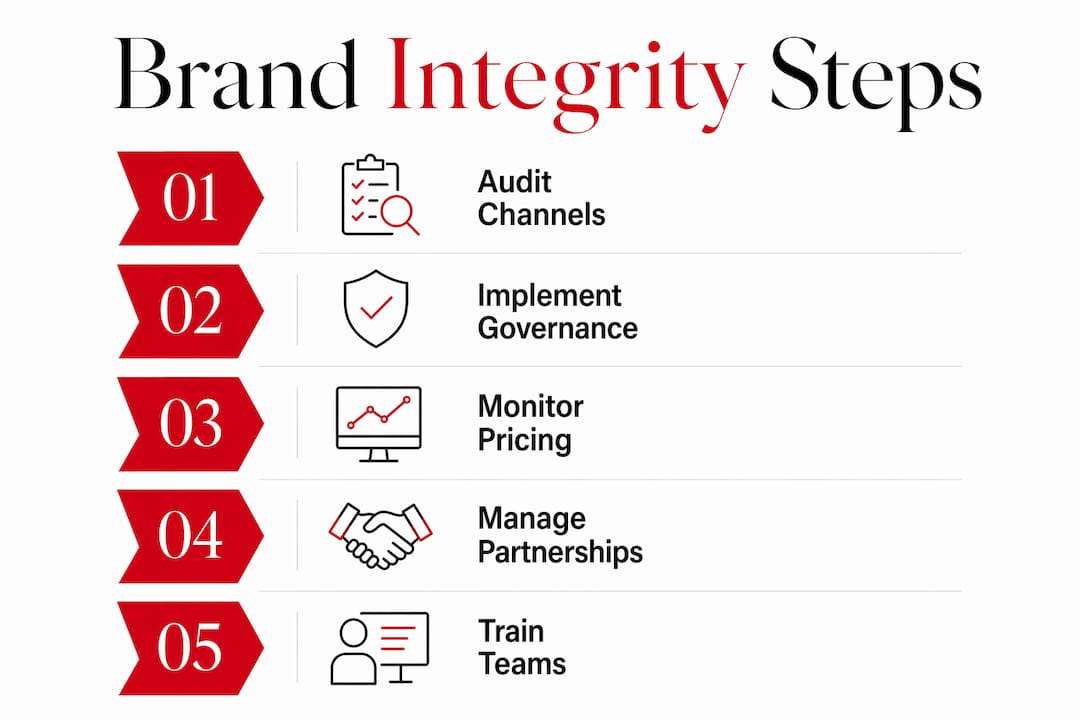
Pro Tip: Conduct a quarterly channel audit that maps every point where your product or brand assets appear publicly, including third-party marketplaces, reseller sites, and social media. Unauthorized appearances are almost always discovered by your customers before your compliance team.
The consequences of brand integrity loss in luxury are asymmetric. Recovery requires years of consistent effort, while the damage itself can occur in weeks. Brands that treat integrity governance as a reactive function rather than a proactive system consistently underestimate this asymmetry.
How do luxury brands operationalize brand integrity at scale?
Brand governance involves systems of guidelines, approval workflows, digital asset management, and risk mitigation to maintain consistency and reduce unauthorized edits. For luxury brands operating across multiple markets, languages, and retail formats, governance is the operational translation of brand values into daily decisions.
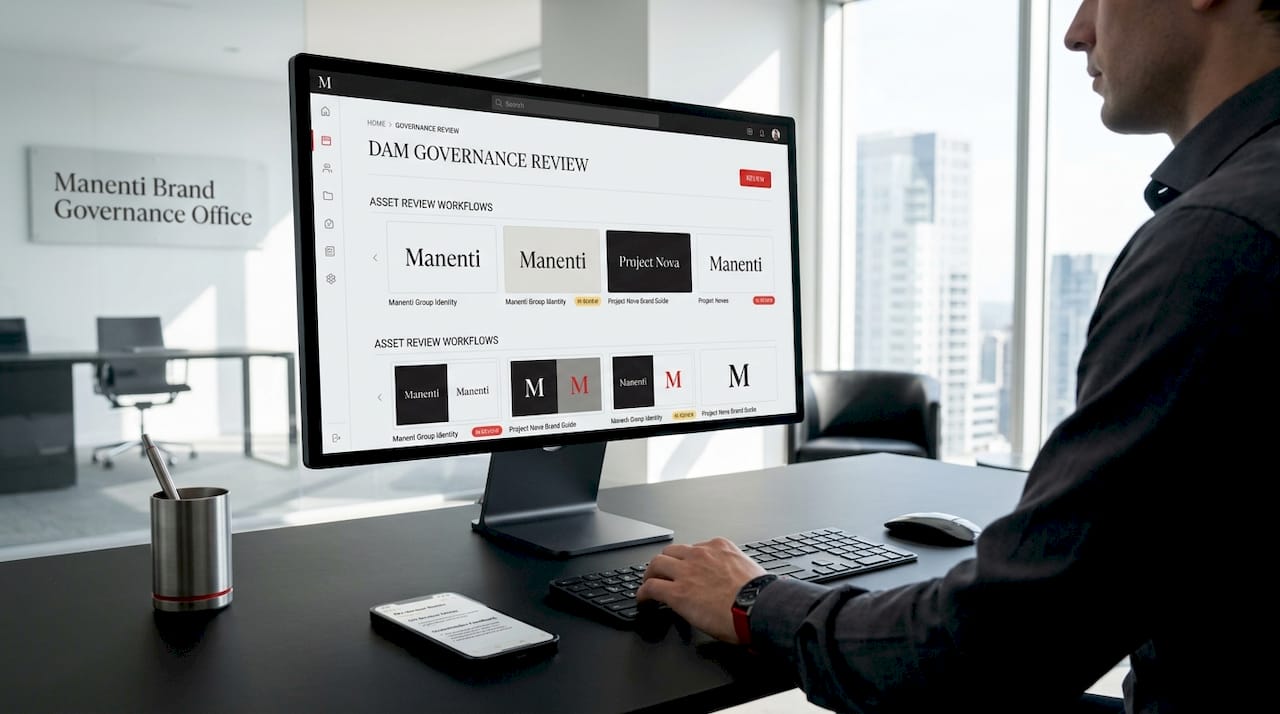
The most effective governance architecture for luxury brand managers includes several interconnected components.
Digital asset management systems. Platforms like Bynder and Canto centralize approved brand assets and make it impossible for regional teams or agency partners to use outdated logos, incorrect color specifications, or off-brand photography. Centralization removes the ambiguity that produces inconsistency.
Approval workflows with tiered access. Effective brand governance locks high-risk elements such as logos and legal copy while permitting controlled customization in lower-risk areas like regional copy or event-specific imagery. This approach maintains brand control without creating bottlenecks that slow market execution.
Vendor and partner compliance frameworks. Channel-partner management is critical in luxury to prevent unauthorized sellers and counterfeits that break brand integrity and trust. Contracts must specify brand usage rights explicitly, and compliance must be audited rather than assumed.
Pricing monitoring technology. Tools that scan marketplaces and reseller platforms for MAP violations provide early warning before price erosion becomes visible to consumers. Reactive enforcement is always more costly than proactive detection.
| Governance element | Purpose |
|---|---|
| Digital asset management | Centralizes approved assets and eliminates unauthorized versions |
| Tiered approval workflows | Controls high-risk elements while allowing regional flexibility |
| Partner compliance audits | Identifies unauthorized resellers and MAP violations early |
| Pricing monitoring tools | Detects price erosion before it reaches consumer awareness |
Training is the governance element most frequently underinvested. Brand guidelines documents are not self-executing. Regional teams, retail staff, and agency partners require structured onboarding and periodic refreshers to apply brand standards correctly under real operating conditions. The brands that maintain brand consistency across channels treat training as a governance function, not a one-time orientation.
How does digital and AI content change brand integrity management?
In the AI era, brand integrity requires establishing guardrails for content placement to avoid inauthentic associations that disconnect from brand values. Generic brand safety lists are insufficient for luxury. A luxury brand appearing adjacent to discount retail content or algorithmically generated low-quality articles suffers a contextual integrity failure even if the content itself is technically brand-safe.
The distinction matters because luxury brands sell context as much as product. Where your brand appears is part of what your brand communicates. Brands must define explicit exclusion rules tied to identity, not just category-level safety filters. This means specifying the types of editorial environments, creator profiles, and platform contexts where brand association is acceptable.
Consumer verification behavior compounds this challenge. Luxury consumers increasingly rely on user-generated content, reviews, and search rankings to validate purchase decisions. Transparency and rapid response systems are therefore not optional reputation management tools. They are integrity infrastructure. A brand that allows negative or misleading reviews to accumulate without response signals to prospective buyers that it does not stand behind its promise.
Pro Tip: Build a digital reputation monitoring protocol that flags brand mentions, review spikes, and unauthorized content appearances within 24 hours. Speed of response is itself an integrity signal to luxury consumers who expect attentiveness as part of the brand experience.
The intersection of AI content generation and brand authenticity creates a specific risk for luxury brands. When AI-generated content lacks the tonal precision, cultural specificity, and emotional depth that luxury consumers expect, it reads as inauthentic even when factually accurate. Brand managers must establish content quality standards that apply to AI-assisted production with the same rigor applied to human-authored materials.
Key takeaways
Brand integrity in luxury is a governance system that protects trust, price credibility, and customer loyalty simultaneously, and its absence produces revenue loss that no campaign can recover.
| Point | Details |
|---|---|
| Integrity drives revenue | Consistent brand presentation increases revenue by 10 to 23% and protects lifetime customer value. |
| Trust enables premium pricing | Without trust, luxury price points become indefensible to consumers and trade partners alike. |
| Governance is operational | Digital asset management, approval workflows, and partner audits translate brand values into daily decisions. |
| Digital context matters | Where your brand appears is as important as what it says; AI era placement requires explicit exclusion rules. |
| Authenticity is non-negotiable | Over half of consumers stop buying after a single inauthentic experience, making end-to-end integrity mandatory. |
The loyalty contract luxury brands cannot afford to break
I have worked with luxury brands that treated brand integrity as a design function. They invested heavily in visual identity systems, produced beautiful guidelines documents, and then watched those guidelines dissolve the moment a regional distributor or a new agency partner entered the picture. The problem was never the guidelines. It was the absence of governance infrastructure to make those guidelines operational.
What I have come to understand is that brand integrity in luxury is fundamentally about protecting a loyalty contract. The 37% of luxury customers who report difficulty sustaining emotional resonance with brands are not failing to connect. They are responding to brands that have allowed integrity gaps to accumulate across touchpoints until the relationship no longer feels coherent.
The brands I have seen maintain genuine integrity over time share one characteristic: they treat it as continuous governance, not a one-time creative exercise. They audit, they train, they monitor, and they respond. They also understand that controlling every element of brand expression is not the goal. The goal is ensuring that wherever flexibility exists, it operates within boundaries that protect the core promise.
The emotional dimension of this work is where most brand managers underinvest. Luxury consumers form attachments to brands that feel consistent not just visually but relationally. When a brand communicates with the same voice, the same values, and the same level of attentiveness across every interaction, it builds what I call relational artisanship. That quality is what transforms a transaction into a relationship and a relationship into lasting emotional loyalty.
The uncomfortable truth is that integrity cannot be delegated entirely to a compliance team or a brand guidelines document. It requires brand managers who understand why the standards exist, not just what they are.
— Corrado
Build your luxury brand on a foundation that holds
Brand integrity is not a constraint on creativity. It is the condition that makes premium positioning sustainable. If you are responsible for a luxury brand and you are navigating the complexity of multi-market governance, digital placement risks, or partner compliance, the strategic frameworks that protect integrity are the same ones that drive growth.
Corradomanenti works with fashion and luxury brands to build the governance systems, messaging frameworks, and psychological strategies that keep brand integrity intact at scale. From channel partner compliance to AI content guardrails, the work is grounded in both luxury market expertise and consumer psychology. Explore the luxury brand growth tactics that Corradomanenti has developed specifically for brands competing at the premium tier, and discover how psychology-driven marketing protects the trust your brand has earned.
FAQ
What is brand integrity in luxury marketing?
Brand integrity is the consistent alignment between a luxury brand’s promises, its delivered experience, and customer perception across all touchpoints. When this alignment holds, it produces trust, price credibility, and durable loyalty.
Why is brand trust essential for luxury pricing?
Trust legitimizes premium pricing by giving consumers confidence that the brand’s stated value is real and consistently delivered. Without trust, luxury price points become difficult to defend against consumer skepticism or competitor pressure.
What are the main consequences of brand integrity loss?
Revenue erosion, price credibility damage, and customer defection are the primary consequences. Research shows over half of consumers stop purchasing after a single inauthentic brand experience, making integrity failures disproportionately costly in luxury markets.
How do luxury brands maintain integrity across digital channels?
Effective digital integrity management requires explicit content placement rules, rapid response systems for reviews and brand mentions, and AI content quality standards that match the tonal and cultural precision luxury consumers expect.
What governance tools support brand integrity at scale?
Digital asset management platforms, tiered approval workflows, partner compliance audits, and pricing monitoring tools form the core governance infrastructure. Brands that build brand presence online with these systems in place maintain consistency across markets without sacrificing execution speed.