
Up to 80% of luxury purchases are driven by emotions, not product attributes. That single finding should reshape how you think about every campaign, every touchpoint, and every brand story you tell. For marketing directors and brand strategists in the luxury space, competing on product quality alone is a losing game. The brands that consistently command premium pricing and fierce loyalty are the ones that understand the psychological architecture behind desire. This article breaks down the core frameworks, the evidence, and the practical steps you need to turn consumer psychology into a genuine competitive advantage.
Table of Contents
- The foundation: Emotional drivers in luxury consumer decisions
- Scarcity, exclusivity, and the science of desire
- Personalization, perception, and cognitive value: Building bonds that last
- Brand equity, value perceptions, and pitfalls of psychological missteps
- Segmenting luxury consumers: Status, uniqueness, and advanced psychology
- How to put luxury consumer psychology to work in your brand
- Frequently asked questions
Key Takeaways
| Point | Details |
|---|---|
| Emotions drive loyalty | Luxury brand loyalty is built primarily on emotional bonds, not product differences. |
| Scarcity boosts desire | Limited editions and exclusivity trigger strong purchase motivation among luxury consumers. |
| Personalization increases sales | Using psychological insights to personalize experiences can lift revenue by 40% for luxury brands. |
| Brand equity is crucial | Reputation, image, and perceived value directly impact purchase decisions in luxury markets. |
| Tailored strategies win | Segmenting consumers by motive—status or uniqueness—enables more effective engagement and outcomes. |
The foundation: Emotional drivers in luxury consumer decisions
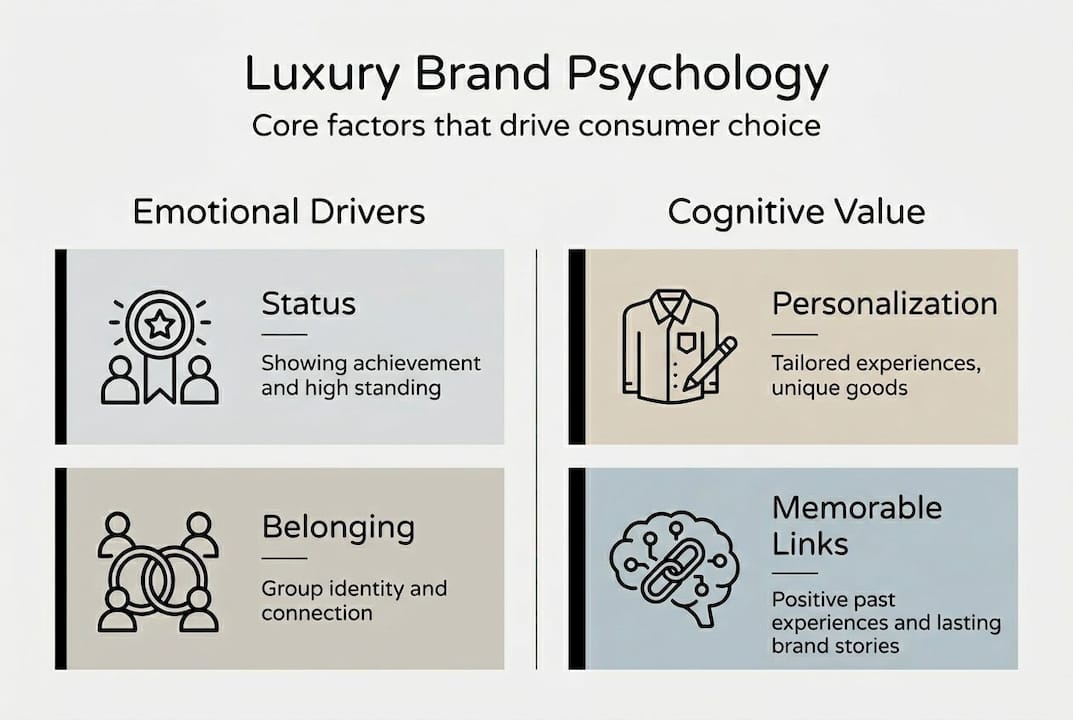
Luxury consumers are not making rational spreadsheet decisions. They are responding to deeply personal psychological forces: the need to signal status, reinforce identity, feel unique, and experience emotional resonance with a brand. These are not soft, abstract concepts. They are measurable, predictable, and actionable.
When you study analyzing high-end consumer behavior, a clear hierarchy emerges. Status signaling sits at the top for many buyers, but emotional connection is what sustains loyalty over time. Prestige branding consumer psychology research confirms that emotional bonds are the core reason for luxury loyalty and premium pricing, not craftsmanship alone.
“Emotional connection drives 70% of luxury brand loyalty.” — McKinsey
Think about how Chanel communicates. It rarely leads with fabric quality or construction. It leads with aspiration, femininity, and a specific vision of freedom. That emotional resonance is engineered, not accidental.
Here are the critical emotional drivers shaping luxury consumer decisions:
- Status signaling: The purchase communicates social position to others
- Identity reinforcement: The brand reflects who the consumer believes they are or aspires to be
- Emotional connection: A felt bond with the brand’s story, heritage, or values
- Need for uniqueness: The desire to stand apart from the crowd
- Hedonic pleasure: The pure sensory and experiential joy of ownership
Every strategy you build should map back to at least one of these drivers. If it doesn’t, you’re spending budget on noise.
Scarcity, exclusivity, and the science of desire
Once the emotional roots are clear, the next layer involves the mechanics of creating desire, especially through scarcity and exclusivity. This is where psychological theory becomes a direct revenue lever.

Reactance theory explains why scarcity and exclusivity increase desire for luxury goods. When consumers perceive that access is limited, their motivation to obtain the item intensifies. Hermès waiting lists, limited-edition drops, and invitation-only collections are not just supply chain decisions. They are psychological engineering.
The impact of rarity and exclusivity on perceived value is well documented across fragrance, fashion, and accessories. Scarcity signals that something is worth having. It also creates urgency without requiring a discount.
| Strategy | Scarcity-driven approach | Broad-market approach |
|---|---|---|
| Pricing | Premium, non-negotiable | Flexible, promotional |
| Availability | Limited, curated | Wide, accessible |
| Consumer emotion | Urgency, desire, pride | Convenience, value |
| Brand perception | Exclusive, aspirational | Accessible, democratic |
| Loyalty driver | Emotional investment | Price sensitivity |
Pro Tip: Frame exclusivity as a privilege, not a barrier. Language like “reserved for our most valued clients” activates positive FOMO without making prospects feel rejected. The goal is to make them want in, not feel shut out. You can explore how elevating luxury customer experience through scarcity mechanics translates directly into stronger brand equity.
Personalization, perception, and cognitive value: Building bonds that last
Beyond creating urgency and appeal, long-term engagement relies on ongoing personalized interactions that build value over time. Personalization in luxury is not about using a customer’s first name in an email. It’s about demonstrating that you understand their psychology, their preferences, and their identity.
Personalization in luxury leads to a 40% revenue lift and 73% higher purchase likelihood. Those are not marginal gains. They represent a fundamental shift in how consumers respond when they feel genuinely seen by a brand.
Cognitive value and interaction-based imprints increase luxury brand loyalty by creating memorable associations that consumers carry long after the transaction. Every touchpoint is an opportunity to leave a psychological imprint.
Here is a snapshot of what the data shows:
| Metric | Impact | Source |
|---|---|---|
| Revenue lift from personalization | +40% | McKinsey |
| Higher purchase likelihood | 73% | Deloitte |
| Loyalty driven by emotional connection | 70% | McKinsey |
| Luxury purchases driven by emotion | 80% | Brainz Magazine |
Practical steps for building cognitive value and lasting brand imprints:
- Map psychological profiles: Go beyond demographics. Understand whether your client is status-driven, uniqueness-seeking, or hedonically motivated.
- Personalize the narrative: Tailor brand storytelling to reflect the consumer’s self-concept, not just their purchase history.
- Design memorable rituals: Packaging, unboxing, and in-store experiences should create sensory memories that reinforce brand identity.
- Follow up with meaning: Post-purchase communication should feel like a continuation of the relationship, not a receipt.
- Leverage data ethically: Use behavioral data to anticipate needs, but always maintain the sense of human curation that luxury demands.
For deeper frameworks on personalizing luxury marketing and understanding luxury personalization strategies, the evidence consistently points to psychology as the multiplier. You can also explore how to use psychology to enhance luxury experience at every stage of the customer journey. The luxury personalization case in niche fragrance is a compelling real-world example of these principles in action.
Brand equity, value perceptions, and pitfalls of psychological missteps
As loyalty and connections develop, the overall impact rests on how brand equity and psychological value are managed. And this is where many luxury brands make costly mistakes.
Brand equity elements including reputation, image, and perceived value drive 80.9% of luxury purchase decisions. That means your brand’s psychological footprint is almost the entire game. Product is table stakes.
Key brand equity components that influence luxury decisions:
- Reputation: Perceived heritage, craftsmanship legacy, and media presence
- Brand image: The emotional and symbolic associations consumers hold
- Perceived value: The gap between price paid and psychological benefit received
- Social proof: Who else is wearing, using, or endorsing the brand
- Consistency: Whether every touchpoint reinforces the same psychological promise
One specific pitfall deserves attention: anthropomorphism. When brands make themselves too relatable, too human, too casual, they risk collapsing the psychological distance that makes luxury desirable. Anthropomorphism decreases luxury value perceptions by reducing the sense of aspiration and exclusivity that consumers are paying for.
Pro Tip: Psychological closeness works well for lifestyle and accessible luxury segments. For ultra-premium positioning, maintain prestige distance. Let the brand feel slightly out of reach. That tension is part of the value. Study traditional luxury brand psychology to see how heritage houses navigate this balance. For a structured approach, reviewing luxury customer journey steps helps identify where closeness helps and where distance protects brand equity. You can also deepen your understanding through analyzing luxury brand equity frameworks.
Segmenting luxury consumers: Status, uniqueness, and advanced psychology
A sophisticated application of consumer psychology recognizes subtle differences between consumer motives. Not all luxury buyers want the same thing, and treating them as a monolith is a strategic error.
Status consumption and need for uniqueness interact in complex ways. High uniqueness needs actually weaken the traditional status-luxury link, meaning that consumers who prize individuality respond poorly to mass-status signals.
Here is how to distinguish the two primary segments:
- Status-driven consumers (bandwagon segment): These buyers want visible, recognizable luxury. They respond to logos, celebrity associations, and social proof. They want to belong to an aspirational group.
- Uniqueness-driven consumers (snob segment): These buyers actively avoid what everyone else has. They seek rare, niche, or bespoke options. Mainstream status cues can actually repel them.
- Hedonic consumers: Motivated primarily by sensory pleasure and personal experience, less concerned with social signaling.
- Perfectionist consumers: Driven by quality and craftsmanship above all else. They respond to technical detail and provenance.
“Tailoring your strategy to the snob segment requires removing mass-market signals entirely. The moment your brand feels too popular, you lose them.” — Consumer psychology research on uniqueness-driven purchasing
For analyzing luxury consumer types within your own customer base, behavioral data combined with psychological profiling gives you the clearest picture. The key is building separate engagement tracks, not a single campaign that tries to speak to everyone and resonates with no one.
How to put luxury consumer psychology to work in your brand
The frameworks in this article are only as valuable as your ability to apply them consistently across every brand touchpoint. Understanding emotional drivers, scarcity mechanics, personalization science, and consumer segmentation is the foundation. Executing them with precision is where the real competitive advantage lives.
Corrado Manenti’s approach combines academic psychology with hands-on luxury marketing expertise to help brands translate these insights into measurable results. Whether you’re refining your positioning, rebuilding your customer journey, or launching a new campaign, the right psychological framework changes everything. Explore luxury market growth tactics for actionable strategies, dive into luxury branding engagement strategies built specifically for 2026, or start with psychology-driven lifestyle branding to align your brand identity with what your consumers actually feel.
Frequently asked questions
How does emotional connection impact luxury brand loyalty?
Emotional connections drive up to 70% of loyalty for luxury brands, making consumers prioritize their bond with a brand over price or competing product features.
Why do scarcity and exclusivity matter in luxury marketing?
Scarcity and exclusivity activate reactance, increasing perceived value and urgency to buy among luxury consumers who interpret limited access as a signal of superior worth.
What is a common mistake when using psychology in luxury branding?
Anthropomorphizing luxury brands can backfire by collapsing the psychological distance that makes a brand feel aspirational, ultimately reducing perceived exclusivity and brand value.
How does personalization impact sales for luxury brands?
Luxury brands that personalize using psychological insights can see a 40% revenue increase alongside significantly higher customer engagement and purchase likelihood.
Can all luxury consumers be influenced by status-based strategies?
No. Status and uniqueness needs interact in ways that make status-driven tactics less effective with consumers who prize individuality, requiring clearly differentiated engagement approaches for each segment.
Recommended
- Psychology in luxury branding: Boost engagement in 2026 – Corrado Manenti
- Understanding Psychology in Luxury Branding – Corrado Manenti
- How to Analyze High-End Consumer Behavior for Luxury Brands – Corrado Manenti
- Unveiling Alexandria vs. Traditional Luxury Brands
- Luxury Jewelry Explained: Key Qualities and Value – Malibu Vibes Jewelry