


TL;DR:
- Luxury brands often face a perception gap that impacts their financial performance. Conducting regular audits with data-driven tools helps identify and close perception gaps. Strategic activation and ongoing measurement are essential to sustain and enhance luxury brand perception over time.
Luxury brands routinely pour millions into campaigns, events, and collaborations, yet consumer perception stubbornly refuses to move. The gap between intended image and actual consumer experience is one of the most frustrating and costly problems in premium marketing. Cutting brand investment costs $1.92 to recover for every $1 reduced, which means perception is not just a soft metric but a financial asset that compounds or erodes over time. This guide walks you through four proven steps to audit, reposition, activate, and measure brand perception improvement, with frameworks built specifically for luxury fashion, automotive, and hospitality leaders.
Table of Contents
- Audit your brand’s current perception
- Define your desired positioning and narrative
- Implement strategies to activate new perceptions
- Measure, refine, and avoid classic luxury missteps
- Why intuition alone fails in luxury brand perception improvement
- Connect with experts to elevate your brand perception
- Frequently asked questions
Key Takeaways
| Point | Details |
|---|---|
| Data-driven audits | Use objective consumer data to diagnose brand gaps rather than relying on intuition. |
| Narrative clarity | Craft a positioning statement anchored in your brand’s true strengths and luxury signals. |
| Consistent activation | Execute perception shifts across all touchpoints with consistent storytelling and experiences. |
| Measure and adapt | Monitor key metrics and refine strategies to avoid costly missteps and ensure growth. |
Audit your brand’s current perception
Before you can shift perception, you need to know exactly where you stand. Most brand leaders believe they already know their image. That confidence is often the first problem. Consumer data over intuition is what marketers should rely on, since intuition regularly misjudges both brand uniqueness and how famous specific elements actually are among target consumers.
Start by separating your intended brand image from your perceived brand image. Your intended image is what your creative briefs, brand guidelines, and leadership team describe. Your perceived image is what clients, prospects, and the broader market actually feel and say. The distance between these two is your audit gap, and closing it is the entire point of this process.
Here are the primary data sources you should pull from during a luxury brand audit:
- Net Promoter Score (NPS): Measures client loyalty and willingness to recommend. In luxury, scores below 40 signal serious perception friction.
- Social media sentiment analysis: Tools like Brandwatch or Sprout Social surface how your brand is discussed organically, not just in response to campaigns.
- Client interviews and VIP feedback sessions: Qualitative depth that surveys cannot capture. Ask clients what three words they associate with your brand.
- Competitive benchmarking: Map your brand attributes against two or three direct competitors to identify where you lead and where you trail.
- Employee perception data: Frontline staff in hospitality and retail often hold the most accurate picture of how clients truly experience the brand.
| Audit tool | Best for | Luxury sector fit |
|---|---|---|
| NPS surveys | Loyalty and advocacy | High |
| Sentiment analysis | Real-time perception | High |
| VIP focus groups | Deep qualitative insight | Very high |
| Competitive benchmarking | Positioning gaps | High |
| Social listening | Organic brand narrative | Medium to high |
“The brands that grow fastest are the ones that treat perception data as a living asset, not a one-time snapshot.” This means scheduling audits at minimum twice per year, not just before a campaign launch.
Pro Tip: When analyzing luxury consumer behavior, always cross-reference your internal brand tracking with third-party data. Internal teams develop blind spots quickly, especially in brands with strong heritage narratives. Use the luxury branding checklist to make sure no critical touchpoint goes unmeasured.
Define your desired positioning and narrative
With clear audit findings in hand, the next step is to strategically recalibrate your brand’s position and narrative. This is not about rewriting your mission statement. It is about deciding, with precision, what emotional and rational territory you want to own in your consumer’s mind.
A strong luxury positioning statement answers three questions: Who is your ideal client? What singular feeling does your brand deliver? Why can only your brand deliver it? The answer to that third question is your real differentiator, and it is where most brands get vague.
In luxury storytelling, sustainability and ethical practices should be embedded as quality signals, not as separate CSR footnotes. Clients at the top of the market increasingly read environmental commitment as a proxy for craftsmanship standards. If your brand ignores this, you are leaving a powerful narrative lever unused.
Here is a comparison of the two dominant positioning approaches in luxury today:
| Approach | Core signal | Pricing power | Search volume | Best suited for |
|---|---|---|---|---|
| Minimalist branding | Restraint, confidence, craft | Very high | Lower | Heritage houses, niche automotive |
| Logo-driven branding | Status, visibility, aspiration | High | Higher | Streetwear-influenced luxury, accessories |
Neither approach is universally superior. The right choice depends on your client profile and the perception gap your audit revealed. What matters most is internal consistency. A brand that oscillates between both signals confuses consumers and weakens recall.
Consider these elements when building your narrative:
- Heritage: Specific founding stories, artisan techniques, or geographic origins that cannot be replicated
- Innovation: Technology integration, material science, or service design that signals forward momentum
- Exclusivity: Limited editions, invite-only experiences, or personalization that reinforces scarcity
- Inclusivity: Carefully selected cultural partnerships that add warmth without diluting prestige
For deeper strategic frameworks, the work on innovative luxury branding strategies offers sector-specific positioning models worth reviewing before finalizing your narrative architecture.
Implement strategies to activate new perceptions
Once you’ve clarified your brand’s desired position, it’s time to activate these insights across brand experiences. Strategy documents do not change perception. Consistent, repeated experiences do.

The iterative rebranding process follows a clear sequence: audit, position, design, activate, and measure. Each stage feeds data back into the next cycle. The brands that fail at activation typically skip the measurement stage, which means they never build the feedback loop that makes refinement possible.
Here is a sequenced activation plan for luxury brand perception improvement:
- Redesign your highest-traffic touchpoints first. For hospitality, this is the arrival experience. For fashion, it is the fitting room and packaging. For automotive, it is the test drive ritual. These moments carry disproportionate emotional weight.
- Train client-facing staff on the new brand narrative. Scripts and service rituals must reflect the repositioned story. Inconsistency at the human level undermines every dollar spent on communications.
- Launch digital exclusivity features. Private client portals, early access programs, and personalized digital content reinforce the feeling of belonging to something rare.
- Align all channel communications within a 90-day window. Social, email, in-store, and PR messaging must shift simultaneously. Staggered rollouts create mixed signals that dilute the new perception.
- Use craftsmanship storytelling in content. Behind-the-scenes video, artisan profiles, and process documentation are among the highest-performing content formats in luxury because they justify price and build emotional attachment.
Pro Tip: Follow the stepwise rebranding process to sequence your activation without disrupting existing client relationships. Abrupt brand pivots alarm loyal clients. Gradual, well-signaled evolution builds curiosity instead of anxiety. For long-term results, focus equally on building luxury brand loyalty through post-purchase rituals and membership experiences.
Measure, refine, and avoid classic luxury missteps
With your strategies deployed, the final step is to track results, learn, and keep your position resilient. Sales figures alone are a poor proxy for perception health. A brand can grow revenue in the short term while quietly losing the prestige that makes it defensible over a decade.
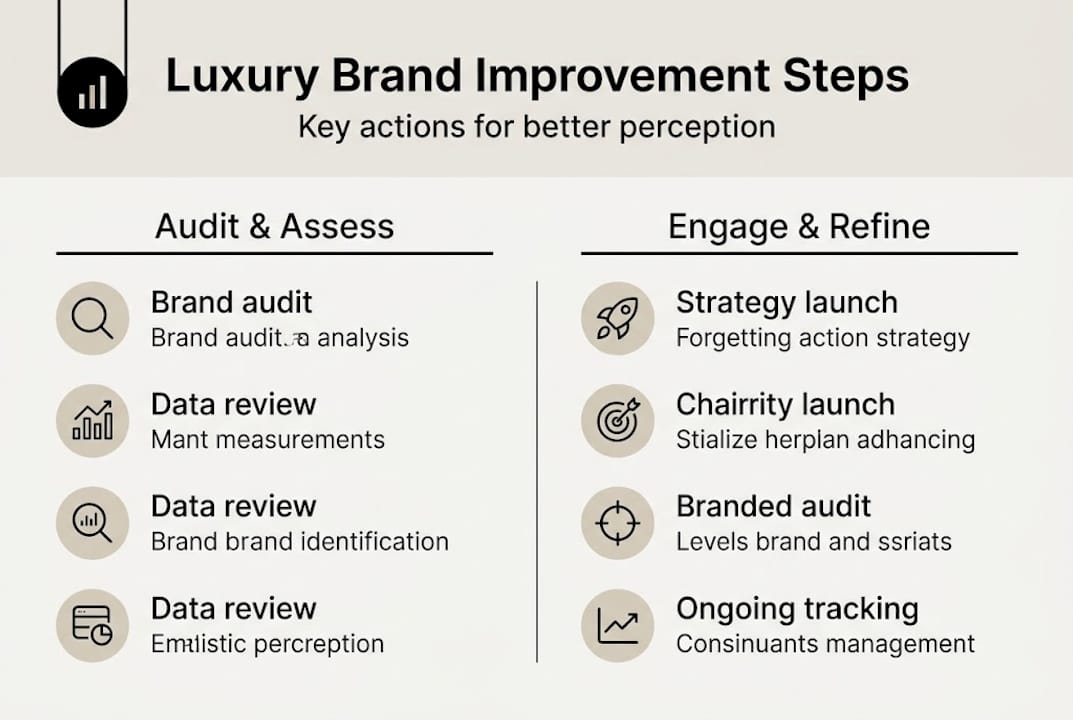
93% of executives see ongoing branding as essential for growth, which confirms that perception investment is not a campaign budget line. It is an operating cost with compounding returns.
The right metrics for luxury perception tracking include:
- Brand consideration rate: Are you on the shortlist when clients are ready to buy?
- Share of voice in premium media: Are you being discussed in the publications and channels your clients trust?
- Sentiment quality score: Not just positive versus negative, but the specific attributes clients associate with your brand
- Repeat purchase and upgrade rate: Loyal clients who trade up within your brand are the clearest signal of strong perception
- Waitlist and reservation demand: In hospitality and automotive, demand signals often precede sales data by six to twelve months
| Metric | Measurement frequency | What it signals |
|---|---|---|
| NPS | Quarterly | Loyalty and advocacy health |
| Sentiment quality | Monthly | Narrative alignment |
| Share of voice | Monthly | Competitive positioning |
| Repeat purchase rate | Annually | Long-term perception strength |
“Brands that over-discount to drive short-term volume are essentially borrowing against their future prestige. The debt always comes due.”
The research is clear: inclusive marketing risks prestige erosion when not balanced carefully, and over-discounting directly undermines brand stature in the luxury segment. Avoid these classic missteps by anchoring every tactical decision to your positioning statement. If a promotion or partnership would not make sense to your ideal client, it probably should not happen.
For a broader framework on sustaining these gains across markets, the global luxury rebranding guide provides region-specific considerations that matter as your brand scales.
Why intuition alone fails in luxury brand perception improvement
Here is an uncomfortable truth most luxury brand leaders do not want to hear: the longer you have been in a market, the more likely your instincts are working against you. Familiarity breeds assumption. Teams that have lived inside a brand for years start to see what they expect to see, not what clients actually experience.
Marketers regularly overestimate which brand elements are famous and underestimate actual brand uniqueness. This means the assets you are most proud of may be invisible to your audience, and the things that genuinely set you apart may be going completely uncommunicated.
Luxury brands are especially vulnerable to echo chambers. Strong heritage narratives, tight creative teams, and high internal pride create cultures where outside criticism is unwelcome. The result is a brand that talks to itself while the market quietly moves on.
The solution is not to abandon your instincts entirely. It is to treat them as hypotheses, not conclusions. Every perception assumption should be tested against real high-end consumer analysis before it drives budget decisions. Bring in external auditors at least once every two years. Competitive monitoring should be ongoing, not reactive. The brands that sustain perception leadership are the ones that stay genuinely curious about what they do not yet know.
Connect with experts to elevate your brand perception
The frameworks in this article give you a solid foundation, but implementation is where most brands stall. Knowing the steps and executing them with precision across a complex organization are two very different challenges.
Working with a specialist who combines psychology-driven insight with deep luxury sector experience accelerates every stage of this process. From auditing perception gaps to designing activation sequences that protect brand equity, expert guidance reduces costly trial and error. Explore luxury brand growth tactics built for fashion, automotive, and hospitality leaders, or start by understanding your clients more deeply through analyzing luxury buyer behavior. For brands ready to go further, the intersection of psychology in luxury branding is where the most durable perception advantages are built.
Frequently asked questions
What are the most important metrics to track brand perception in luxury?
Net Promoter Score, client sentiment analysis, and luxury-focused brand tracking are the top metrics for measuring perception shifts and engagement. Empirical benchmarking and ongoing perception tracking are essential to sustaining luxury brand health over time.
How often should a luxury brand revisit its positioning statement?
Review your positioning at least annually, or after major market or consumer shifts, to stay ahead of trends and competitive change. Iterative processes and frequent measurement are what keep luxury brands competitive rather than reactive.
Can inclusivity damage a luxury brand’s prestige?
Handled carelessly, inclusivity can erode perceived exclusivity, but thoughtful integration usually enhances brand warmth without loss of status. Inclusive marketing boosts warmth but risks prestige if it is not balanced against the brand’s core exclusivity signals.
What’s a first step for brands aiming to improve perception quickly?
Begin by collecting fresh client and employee feedback to map gaps between your intended and actual image. Empirical benchmarks and structured audit steps set the stage for effective and measurable perception shifts.
Are minimalist luxury brands more successful today?
Minimalist luxury branding delivers higher pricing power but may generate less search volume than logo-centric approaches. Bottega Veneta’s minimalist branding is a clear example of strong pricing power achieved with lower organic search presence.
Recommended
- Stepwise Luxury Rebranding Process for Market Leadership – Corrado Manenti
- Step by Step Luxury Rebranding for Global Excellence – Corrado Manenti
- Blog – Corrado Manenti
- Essential Checklist for Luxury Branding Success – Corrado Manenti
- How to Maximise Safari Adventure for Unforgettable Luxury – Namibia Luxury Safaris | Book Your 2025/2026 Adventure Today