


TL;DR:
- Emotional branding creates deep consumer connections based on feelings and shared identity rather than product features. It boosts customer lifetime value and profitability, especially in luxury, by fostering loyalty and resistance to competitors. Building a single authentic emotional territory and aligning touchpoints strengthen brand loyalty and long-term growth.
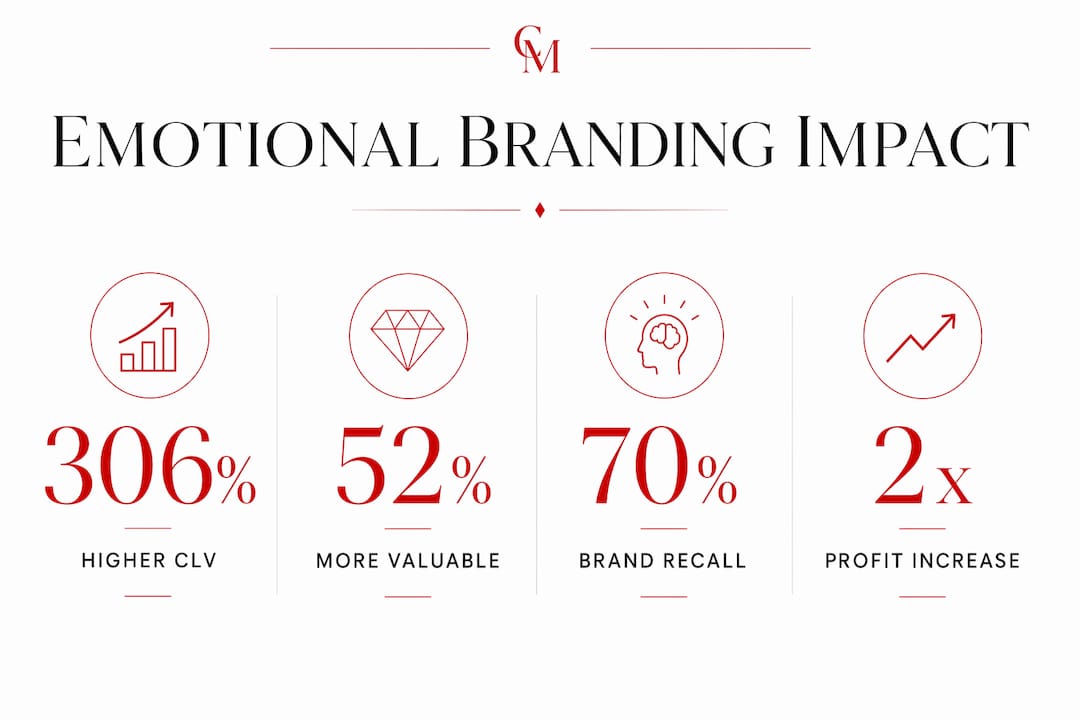
Emotional branding is defined as the practice of building consumer connections through feelings, shared identity, and values rather than product features or rational benefits. The benefits of emotional branding are measurable and significant: emotionally connected customers deliver 306% higher customer lifetime value compared to merely satisfied customers. Brands like Dove, with its Real Beauty campaign, and John Lewis, with its annual Christmas storytelling, have turned emotional resonance into a competitive moat that no product specification can replicate. For luxury brand strategists, this is not a soft concept. It is the most defensible growth engine available.
What are the measurable benefits of emotional branding?
Emotional branding advantages go well beyond brand sentiment scores. Emotional advertising generates twice the profit of rational advertising, based on an analysis of 880 marketing campaigns. That gap exists because emotional campaigns build long-term memory structures that rational campaigns simply do not.
The financial case becomes even clearer at the customer level. Emotionally connected customers are 52% more valuable than highly satisfied customers. Satisfaction is a ceiling. Emotional connection is a multiplier.
Not every customer reaches full emotional attachment, and that is fine. Only about 25% of consumers achieve full-strength emotional bonding with a brand, but that group drives a disproportionate share of purchases. In luxury, where a small percentage of clients generates the majority of revenue, this concentration effect is especially powerful.
The core emotional branding advantages for luxury brands include:
- Higher purchase frequency from clients who feel personally identified with the brand
- Premium pricing tolerance, because emotionally bonded clients do not comparison-shop on price
- Resistance to competitor switching, since the brand becomes part of the client’s self-identity
- Word-of-mouth amplification, as emotionally connected clients advocate without being asked
- Greater resilience during brand crises, because trust built on feeling is harder to erode than trust built on features
Pro Tip: Map your current customer base by emotional attachment level, not just spend tier. Your top 25% by emotional bonding will almost always outperform your top 25% by transaction value.
| Metric | Emotional branding impact |
|---|---|
| Customer lifetime value | 306% higher vs. satisfied customers |
| Advertising profitability | 2x vs. rational campaigns |
| Customer value vs. satisfied | 52% higher |
| Core bonded buyer share | ~25% of customers, outsized purchase share |
How does emotional branding differ from rational marketing?
Rational marketing focuses on product attributes, price comparisons, and feature lists. It works for short-term activation. Emotional branding builds the long-term equity that makes a brand the default choice before a client even enters a store or opens an app.
The critical distinction is time horizon. Rational tactics win transactions. Emotional branding wins relationships. A luxury client who chooses a brand because of a feature will leave when a competitor offers a better feature. A client who chooses a brand because it reflects who they aspire to be will stay regardless.
“The purpose of emotional branding is to help customers feel a positive self-identity related to the brand, not just feel about the product itself.” — Advergize
A common failure mode is what practitioners call the “everything bagel” problem: trying to evoke multiple emotions across different campaigns until the brand owns none of them. Owning one core emotion consistently across all touchpoints is what builds mental availability. Brands that chase joy, excitement, and nostalgia simultaneously end up with none of the three.
| Approach | Time horizon | Primary outcome | Loyalty type |
|---|---|---|---|
| Rational marketing | Short-term | Transaction | Conditional |
| Emotional branding | Long-term | Relationship | Identity-based |
| Combined strategy | Both | Profitability + loyalty | Durable |
The combined approach, long-term emotional branding paired with short-term rational activation, produces the strongest results. But the emotional layer must come first. It sets the context in which every rational message lands.
Which emotional branding strategies work best in the luxury sector?
The most effective luxury emotional branding strategy starts with a single, ownable emotional territory. Not a mood board. Not a list of values. One feeling that is truthful to the brand, unique in the category, and deliverable at every touchpoint.
Choosing that feeling requires honest internal work. The emotion must be authentic to the brand’s history and product experience. Hermès does not own excitement. It owns quiet confidence. That distinction shapes every design decision, every piece of copy, and every client interaction.
Once the emotional territory is defined, design tokens become the delivery mechanism. Color palettes, typography choices, spacing, and microcopy all carry emotional signals. Design tokens linked to emotional territories prevent emotional drift as brands scale across digital and physical channels. Without them, a brand’s emotional promise fractures across touchpoints.
Storytelling is the third pillar. Narrative arcs that place the client as the protagonist, not the product, create shared identity. Dove’s Real Beauty campaign worked because it made women the heroes of their own stories. The product was secondary. The feeling of being seen and valued was primary.
Key strategies for luxury emotional branding:
- Define one ownable emotion aligned with brand heritage and client aspiration
- Build a design token system that encodes the emotional territory into every visual and verbal element
- Use narrative arcs that center client identity, not product features
- Align emotional promises with product performance so the feeling is earned, not manufactured
- Audit touchpoints quarterly to catch emotional drift before it erodes mental availability
Pro Tip: Test your emotional territory by asking this question: if a client described your brand to a friend using only one feeling, what would that feeling be? If your team gives five different answers, you do not yet own an emotion.
Emotional branding in fashion follows the same principles but with higher stakes. Fashion clients use brands to signal identity to others. The emotional territory must be aspirational enough to attract and specific enough to exclude. Exclusivity is itself an emotion in luxury.
How can emotional branding impact customer experience and brand identity?
Emotional branding impact on customer experience is structural, not cosmetic. Emotional UX increases brand recall by 70% and trust scores by 30–40%. Those numbers reflect a neurological reality: emotions function as memory tags. A client who feels something during a brand interaction will remember it. A client who feels nothing will not.

The practical framework is what Stormbrain calls the “traceable chain.” Every emotional goal, from the brand’s core feeling down to a micro-moment in a mobile interface, must be connected and intentional. A luxury e-commerce checkout that feels cold and transactional breaks the emotional promise made by the brand’s campaign. That break costs more than a poor ad.
Emotional drift is the silent killer of brand identity. It happens when different teams, agencies, or markets interpret the brand’s emotional territory differently. The result is a fragmented experience that confuses clients and weakens brand consistency. Preventing drift requires documented emotional guidelines, not just visual brand guidelines.
The identity impact extends to pricing power. Clients who feel a strong emotional connection to a brand do not evaluate price the same way. The brand becomes a reference point for their self-image. Switching to a cheaper competitor carries a psychological cost that the competitor’s price advantage cannot offset.
- Map every client touchpoint against the brand’s core emotional territory
- Identify where the emotional experience breaks or weakens
- Assign ownership of each touchpoint to a specific team with clear emotional KPIs
- Use design tokens to enforce emotional consistency across digital and physical channels
- Review the full chain quarterly and update based on client feedback and sentiment data
| Touchpoint category | Emotional branding risk | Mitigation approach |
|---|---|---|
| Digital UX | Cold, transactional feel | Emotional design tokens in UI system |
| Customer service | Inconsistent tone | Emotional territory training for all staff |
| Packaging | Generic presentation | Sensory design aligned to brand feeling |
| Campaign creative | Mixed emotional signals | Single emotion brief for all agencies |
How can luxury brands measure and optimize the ROI of emotional branding?
Measuring emotional branding effectiveness requires tracking customer lifetime value, brand love scores, Net Promoter Score, and social sentiment analysis together. No single metric tells the full story. The combination reveals whether emotional investment is translating into financial outcomes.
Customer lifetime value is the anchor metric. A rising CLV among clients acquired through emotional campaigns confirms that the strategy is working at the revenue level. NPS captures the advocacy dimension: emotionally bonded clients recommend without incentive. Brand love scores, tracked through surveys or social listening tools, measure the depth of emotional attachment over time.
A/B testing applies to emotional branding too. Testing two creative executions, one leading with the brand’s core emotion and one leading with product features, against the same audience generates direct evidence of which approach drives stronger downstream behavior. The test must run long enough to capture repeat purchase data, not just click-through rates.
Key performance indicators for emotional branding ROI:
- Customer lifetime value segmented by emotional attachment level
- Net Promoter Score tracked quarterly across client cohorts
- Brand love scores measured through structured surveys or social listening platforms
- Social sentiment analysis monitoring the emotional language clients use about the brand
- Purchase frequency and premium willingness tracked against emotional campaign exposure
Pro Tip: Run a cohort analysis comparing clients acquired through emotional campaigns versus promotional campaigns. Track their CLV, return rate, and NPS over 12 months. The data will make the case for emotional branding investment more convincingly than any benchmark study.
Analyzing buyer behavior is the foundation of this measurement work. Emotional branding ROI is not visible in last-click attribution models. It shows up in retention rates, share of wallet, and the willingness to pay full price. Luxury brands that measure only short-term conversion metrics systematically undervalue their emotional branding investment.
Key Takeaways
Emotional branding is the most durable competitive advantage available to luxury brands because it converts client identity into loyalty that price and features cannot displace.
| Point | Details |
|---|---|
| Lifetime value multiplier | Emotionally connected clients deliver 306% higher CLV than satisfied clients. |
| Own one emotion | Brands that own a single, consistent feeling build stronger mental availability than those chasing multiple emotions. |
| Design enforces feeling | Design tokens linked to emotional territories prevent brand drift across digital and physical channels. |
| Measure the right metrics | Track CLV, NPS, brand love scores, and social sentiment together to validate emotional branding ROI. |
| Luxury requires authenticity | Emotional promises must be backed by superior product performance or they create distrust, not loyalty. |
Why I think most luxury brands are playing emotional branding too safe
Working with luxury brands across fashion and lifestyle, I see the same pattern repeatedly. The brand commits to emotional branding in the campaign brief, then dilutes it at every subsequent decision. The photography gets softened. The copy gets hedged. The retail experience gets standardized. By the time the client encounters the brand, the emotional territory has been averaged into nothing.
The brands that win on emotion are the ones willing to exclude. Owning a feeling means some clients will not connect with it. That is not a failure. That is the strategy working. A brand that tries to feel right for everyone ends up feeling like nothing to anyone.
The other mistake I see is treating emotional branding as a campaign layer rather than an operating system. Emotional brand connections must be built into every decision: hiring, product development, packaging, client services, and digital UX. When the emotional territory lives only in the marketing department, it fractures the moment a client calls customer service or opens a package.
The data supports going deeper, not broader. A traceable chain from emotional goal to interface micro-moment is not a theoretical exercise. It is the difference between a brand that clients feel and a brand that clients merely recognize. Recognition is cheap. Feeling is the asset.
— Corrado
How Corradomanenti helps luxury brands build emotional depth
Corradomanenti works with fashion and luxury brands that want emotional branding to function as a growth engine, not a creative exercise.
The approach combines psychology-driven consumer analysis with hands-on brand strategy to identify the single emotional territory a brand can own authentically. From there, the work covers touchpoint auditing, design system alignment, and campaign development grounded in behavioral data. For brands ready to move from awareness to deep client loyalty, the luxury brand growth tactics available through Corradomanenti provide a structured path from emotional strategy to measurable revenue outcomes. Every recommendation connects emotional promise to product reality, because in luxury, the two must be inseparable.
FAQ
What is emotional branding in luxury marketing?
Emotional branding in luxury marketing is the practice of building client connections through a consistent, ownable feeling tied to brand identity rather than product features. It positions the brand as part of the client’s self-image, which drives loyalty and premium pricing tolerance.
Why do emotionally connected customers have higher lifetime value?
Emotionally connected customers are 52% more valuable than highly satisfied customers and deliver 306% higher customer lifetime value because they buy more frequently, resist competitor switching, and advocate without incentive.
How does emotional branding differ from a standard marketing campaign?
A standard campaign activates short-term transactions. Emotional branding builds long-term memory structures and identity associations that make a brand the default choice across all future purchase decisions.
What metrics measure emotional branding ROI?
The most reliable metrics are customer lifetime value segmented by emotional attachment, Net Promoter Score, brand love scores, and social sentiment analysis. Together they show whether emotional investment translates into financial outcomes.
Can emotional branding backfire for luxury brands?
Yes. Emotional promises without product excellence create perceived inauthenticity and erode trust, especially in high-involvement luxury categories where clients scrutinize every detail of the brand experience.