

TL;DR:
- Luxury clients respond emotionally to signals of exclusivity, narrative, belonging, and perceived investment.
- Effective luxury sales focus on initiating an emotional shift before presenting rational details to build trust and loyalty.
Ask a high-net-worth client why they bought that Patek Philippe or commissioned a custom villa interior, and they’ll tell you something about craftsmanship, heritage, or a unique personal connection. Rarely will they say “the specs convinced me” or “the price was right.” Yet many luxury sales teams still structure their pitches around product features, technical details, and competitive pricing tiers. That disconnect is where conversions stall and relationships stay shallow. Luxury sales techniques work by accelerating an emotional shift first and rationalizing second, not by leading with facts. This guide shows exactly how to operationalize that principle into every stage of your sales process.
Table of Contents
- Understanding the emotional triggers in luxury sales
- Core emotion-based techniques: Scripts, framing, and exclusivity
- Operationalizing emotional intelligence in brand ambassador interactions
- Emotional negotiation: Building trust with high-value clients
- A luxury perspective: What most brands miss about emotional sales
- Enhance your luxury sales strategy with expert guidance
- Frequently asked questions
Key Takeaways
| Point | Details |
|---|---|
| Emotion first, rationale second | Luxury sales succeed best when emotional shifts are made before rational persuasion begins. |
| Narrative and exclusivity | Telling the right story and offering exclusivity activate key emotional levers for high-value buyers. |
| Scripts define outcomes | Consistently using emotion-driven scripts boosts conversion and retention in measurable ways. |
| Trust outranks price | Buyers who signal trust and care can close deals even against higher competing offers. |
Understanding the emotional triggers in luxury sales
Luxury purchases happen in the emotional brain before the rational brain ever signs off. The rational mind builds the justification afterward. That sequence is critical. If your sales team front-loads facts, they’re building a case for a verdict that the client’s emotion hasn’t reached yet. The investment logic never lands because the emotional “yes” hasn’t been earned.
Understanding emotional engagement in luxury sales starts with knowing which triggers move high-net-worth clients. These aren’t the same as mass-market emotional appeals. They operate on a more refined register.
The four dominant emotional triggers in ultra-premium sales:
- Exclusivity: The client must feel they are accessing something not available to everyone. This isn’t just about limited editions. It’s about the language, the access, and the atmosphere of the interaction itself.
- Narrative: Heritage, craftsmanship stories, and the brand’s founding mythology create emotional context that makes ownership feel meaningful rather than transactional.
- Belonging: High-net-worth clients want to join a circle of people who understand a certain level of taste, achievement, or lifestyle. Your brand should signal that circle clearly.
- Perceived investment: The emotional reframe from “spending” to “investing” is not semantics. It fundamentally changes how the brain evaluates the decision.
| Emotional trigger | What it signals to the client | Common mistake to avoid |
|---|---|---|
| Exclusivity | “This is rare and reserved for you” | Offering the same access to everyone |
| Narrative | “This purchase has meaning beyond the object” | Leading with product specs instead |
| Belonging | “You’re part of an elevated circle” | Transactional or impersonal language |
| Perceived investment | “This grows in value, financially or personally” | Using the word “price” or “cost” |
The most damaging misstep luxury teams make is treating emotion as a closing technique rather than a foundation. Tacking on a romantic brand story at the end of a feature-heavy pitch feels exactly like what it is: an afterthought. Clients at this level have sharp social antennae. They recognize performative warmth immediately, and it erodes trust faster than a clumsy price negotiation.
“The emotional shift must come before the rational evaluation. Leading with specifications is asking the client to make a decision with the wrong part of their brain.”
Core emotion-based techniques: Scripts, framing, and exclusivity
With the triggers clear, we can move into the practical craft: how luxury sales teams can operationalize emotion-based methods day to day. The mechanics aren’t complicated, but they require discipline and consistency across every client-facing moment.
The most powerful shift is moving from product-centric language to identity-centric language. Narrative, identity, and exclusivity framing including scarcity, restricted access, and the concept of belonging to a circle are the proven mechanics of prestige sales. Replacing price language with investment and value language is not optional. It’s structural.
Comparison: Rational selling vs. emotion-based selling
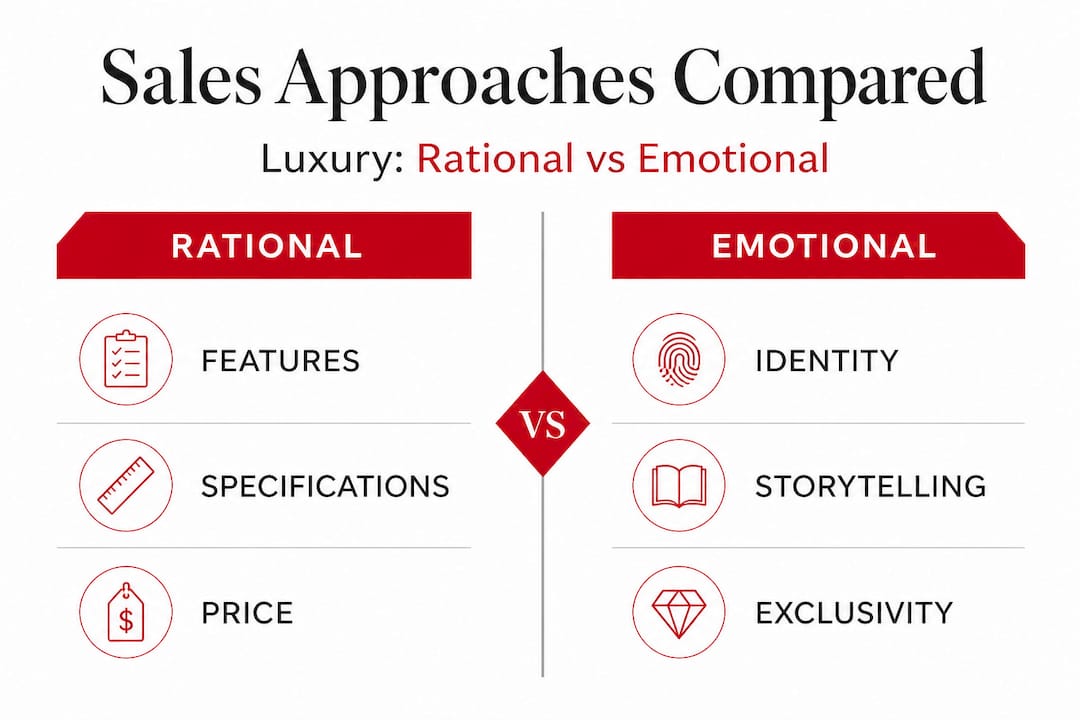
| Rational selling approach | Emotion-based selling approach |
|---|---|
| “The retail price is €45,000” | “Your investment in this piece starts at…” |
| “This model has X technical features” | “This watch has been carried by three generations of one family” |
| “We can offer a discount for a quick decision” | “Pieces at this access level rarely return to availability” |
| “Purchase includes a two-year warranty” | “Acquiring this connects you to a lineage of…” |
| “This is our best-selling model” | “Very few clients are offered this configuration” |
Here is a practical four-step sequence for deploying emotion-based techniques in live interactions:
- Diagnose the motivation. Before presenting anything, ask open questions that reveal what the client is really seeking. Is it status recognition? Family legacy? Personal milestone? The answer shapes everything that follows.
- Open with narrative. Introduce the brand or product through a story that mirrors what you’ve just learned about the client’s motivation. Connect heritage or craftsmanship to their specific aspiration.
- Apply exclusivity framing. Signal that this interaction, this access, or this configuration is not standard. Make the client feel that being here, right now, is itself a mark of distinction.
- Reinforce the value language. Replace every instance of “price,” “buy,” or “purchase” with “investment,” “acquire,” and “join.” This is not marketing polish. It’s a consistent psychological signal that reframes the entire decision.
Pro Tip: After every client interaction, have your team replay the conversation and flag any moments where they defaulted to rational language under pressure. Tension points in a sale are exactly when emotional framing matters most and when teams most often abandon it. Choreograph responses to those moments in advance.
Exploring the full range of emotional triggers in marketing for luxury audiences reveals how these techniques compound over time. A client who consistently experiences identity-reinforcing, narrative-rich interactions develops a loyalty that no discount program can replicate.
Operationalizing emotional intelligence in brand ambassador interactions
After mastering narrative and framing, teams must reliably deliver emotions through consistent behaviors. This is where most programs fall apart. The strategy exists. The scripts are written. But the front-line ambassador reverts to transactional habits the moment a client walks in with a question about specs or delivery timelines.

Emotional intelligence, in this context, means the ability to read a client’s emotional state in real time, adapt your language and pace accordingly, and guide the interaction toward connection rather than transaction. It’s a skill, and like any skill, it can be trained, measured, and improved.
What operationalized emotional intelligence looks like in practice:
- Ambassadors who adjust their tone and vocabulary based on cues the client gives in the first 90 seconds of interaction
- Scripts that include branching language depending on whether the client signals status-seeking, legacy-building, or aesthetic investment as their primary motivation
- Regular review sessions where managers listen to recorded or role-played interactions and coach for emotional fluency, not just product knowledge
- Clear language substitutions embedded in training materials: “investment” instead of “price,” “acquire” instead of “buy,” “join” instead of “sign up”
The results of systematic emotional intelligence training are measurable. Luxury service interactions can be converted into measurable sales outcomes when emotional intelligence is operationalized into scripts and behaviors for brand ambassadors. One case study reports a 3 to 4% immediate uplift in conversion after training. At the average transaction value typical of ultra-premium brands, that number is significant.
A 3 to 4% conversion increase doesn’t sound dramatic until you apply it to a client base where average transactions run into five or six figures.
Boosting luxury loyalty through emotionally intelligent interactions is not about making every ambassador a therapist. It’s about giving them a reliable framework for recognizing what a client needs emotionally in that moment and delivering it with precision. And emotional branding in fashion shows clearly that the emotional consistency between in-store, digital, and post-sale interactions determines whether a client becomes a genuine advocate or simply a one-time buyer.
Pro Tip: Build a monthly “language audit” into your team’s routine. Have reps submit their most challenging client exchanges for group review, specifically looking for moments where price language crept back in. This creates accountability and keeps the emotional framing sharp without feeling punitive.
Emotional negotiation: Building trust with high-value clients
Now that sales interactions are emotionally fluent, let’s apply these principles to high-stakes negotiations. This is the arena where the temptation to revert to financial logic is strongest, and where emotional intelligence delivers its most counterintuitive returns.
Standard negotiation training tells you to maximize your financial position and concede as little as possible. In luxury markets, that framework is incomplete. Empirical research on negotiation shows that emotional attachment changes seller behavior, including how sellers evaluate buyers based on perceived caretaking attributes and trustworthiness. Sellers often prefer buyers who signal care and stewardship over those who simply offer more money.
That finding has direct implications for how your team approaches buyer behavior for luxury brands. The client who communicates genuine appreciation for what they’re acquiring, who signals that they understand its value and intend to honor it, holds a stronger negotiating position than the buyer who signals purely financial motivation.
Here is a four-step framework for running emotionally intelligent negotiations with high-value clients:
- Prepare trust-building behaviors before the meeting. Know the client’s history, their previous acquisitions, and what they’ve communicated about their motivations. Reference these authentically in the conversation. Clients notice when you’ve paid attention.
- Open with acknowledgment, not agenda. Begin by reflecting what you understand about what this acquisition means to them. Not as a sales tactic. As a genuine statement that you’ve listened. This immediately differentiates you from every other negotiation they’ve experienced.
- Listen actively for emotional cues during the discussion. Note moments when their language shifts from measured to excited, or when they hesitate. Hesitation in luxury negotiation is rarely about money. It’s usually about identity or fear of regret. Address those directly.
- Prioritize the long-term relationship over the single win. If you need to create flexibility in a negotiation, frame any accommodation as a reflection of the relationship rather than a financial concession. “Because of what this means to you, and because of the relationship we’re building” is more powerful than any percentage point.
In luxury negotiation, the client who feels emotionally seen and respected will pay the full ask and refer three colleagues. The client who feels processed will find another brand at the first opportunity.
A luxury perspective: What most brands miss about emotional sales
Having explored techniques and negotiation, let’s consider what even expert teams often overlook. The uncomfortable truth is that most “emotional selling” programs in luxury are still fundamentally rational at their core. They’ve added an emotional layer on top of a product-centric structure and called it transformation.
Emotional storytelling tacked onto a product-centric interaction will fail. The critique isn’t about the quality of the story. It’s about timing and architecture. If the interaction is structured around what the product does, adding a heritage narrative at the close doesn’t rewire the client’s emotional experience of the sale. It just decorates it.
The brands that consistently convert at the highest rates don’t just tell better stories. They architect the entire interaction so that the emotional experience is what the client is navigating from the first moment of contact. The story, the exclusivity, the identity reinforcement: these are not additions to the sales process. They are the sales process.
This requires a different kind of audit than most luxury brands currently run. They measure product knowledge and closing rates. Elite brands also audit the emotional texture of every touchpoint, including what happens in the first 30 seconds of a client call, how waiting areas feel, what language appears in follow-up emails, and how sales psychology steps are embedded in every client-facing system.
Most brands don’t train their teams to choreograph human moments deliberately enough. They train them to respond to objections, not to create emotional states. That’s the gap between brands that build loyalty and brands that build transactions.
Enhance your luxury sales strategy with expert guidance
If the principles in this guide resonate, the next question is execution: how do you systematically embed emotion-based selling into a team’s daily behaviors, scripts, and client interactions without losing the spontaneity that makes luxury experiences feel genuine?
That’s precisely the work Corrado Manenti does with luxury and fashion brands. From psychology-driven sales training to full consulting engagements that redesign the emotional architecture of client interactions, the approach is always grounded in behavioral evidence and calibrated to the specific identity of the brand. If you’re ready to move from theory to measurable outcomes, explore the fashion marketing guide for a step-by-step framework, or review the full approach to experiential marketing for luxury brands to see how these principles extend across every client touchpoint.
Frequently asked questions
Why do emotion-based sales outperform rational appeals in luxury?
High-net-worth clients make luxury purchase decisions emotionally first and rationalize them afterward. Leading with emotional triggers rather than product features aligns with how the decision actually forms in the client’s mind.
What common mistake do brands make with emotional selling?
Most brands add emotional messaging at the end of a product-centric pitch rather than building it into the interaction’s entire structure. Emotional storytelling tacked on as a closing tactic is detectable and erodes credibility instead of building it.
How can emotional intelligence training impact sales metrics?
The impact is immediate and measurable. One case study reports a 3 to 4% uplift in conversion rates directly after operationalizing emotional intelligence into brand ambassador scripts and training programs.
Why do sellers sometimes accept lower offers from “caring” buyers?
Trust and perceived stewardship carry real weight in luxury negotiations. Sellers prefer buyers who communicate caretaking intentions and genuine appreciation for what they’re acquiring, even when those buyers present relatively less attractive financial terms.