
TL;DR:
- Digital media presence influences luxury brand perception more than product quality or heritage.
- Measuring ongoing digital signals like sentiment, engagement, and search behavior helps protect brand equity.
- Strategic use of entertainment, interaction, trendiness, customization, and influencer partnerships drives growth.
Luxury brands have long operated on an elegant assumption: exceptional product quality and storied heritage speak for themselves. That assumption is wrong, and the gap between perception and reality is growing fast. In 2026, even the most storied fashion house can lose market share to a newer brand that simply shows up more credibly across digital channels. Media presence, meaning your brand’s visibility and sentiment across both digital and traditional platforms, now shapes purchasing intent before a single conversation with a sales associate ever happens. This guide unpacks the data, frameworks, and tactics that help brand managers turn media visibility into measurable luxury brand equity.
Table of Contents
- Why media presence matters for luxury brands
- How media visibility builds brand equity: Data and frameworks
- Attributes of media presence that drive luxury brand growth
- Leveraging influencers and partnerships to amplify media presence
- A new luxury paradigm: Media presence as the highest form of brand value
- Accelerate your luxury brand’s media presence with proven strategies
- Frequently asked questions
Key Takeaways
| Point | Details |
|---|---|
| Media presence is foundational | Consistent, strategic media presence is now essential for luxury branding success. |
| Measure what matters | Rely on real-time, multi-channel metrics like sentiment and engagement over outdated survey methods. |
| Attributes drive growth | Interactive, trend-driven, and customized media touchpoints have the most impact on brand equity. |
| Partnerships amplify reach | Smart influencer and celebrity partnerships boost both visibility and credibility for luxury brands. |
Why media presence matters for luxury brands
For decades, the luxury sector treated restraint as a form of excellence. Limited advertising, curated editorial placements, and velvet-rope exclusivity were the gold standard. The logic made sense in a media landscape where print publications and high-production television campaigns controlled the narrative. That landscape no longer exists.
Today’s affluent consumers, particularly those in the 25 to 45 age bracket who now represent a massive share of luxury spending, gather purchase signals from social feeds, search engines, and peer communities before they ever enter a boutique. Their perception of your brand is shaped not just by what you say about yourself, but by the volume and quality of what others say.
This shift demands a redefinition of what media presence actually is. It is not simply the number of Instagram posts published per week or the number of press releases sent to editors. Media presence is the aggregate of your brand’s visibility (how widely you appear) and sentiment (whether the conversation around you is positive, neutral, or negative) across every channel where your target audience forms opinions.
“Brands can evaluate digital brand equity using large-scale, unsolicited online consumer data (sentiment, reach/engagement, and search behavior) rather than relying solely on retrospective surveys.”
That distinction matters enormously. Retrospective surveys, which have been the backbone of brand health tracking for generations, capture how consumers felt two to six months ago. Digital media signals tell you what they think right now.
Two critical misconceptions keep luxury brand managers in a dangerous blind spot:
- Visibility is not prestige. Appearing everywhere without curatorial intent actually erodes brand value. Presence must be strategic and consistent with your positioning.
- Digital word of mouth is underestimated. A single viral conversation, whether positive or negative, can shift brand perception faster than any campaign. Monitoring and influencing this conversation is not optional anymore.
Protecting brand reputation in luxury requires treating media presence as an always-on discipline rather than a campaign-specific activity. Brands that approach it this way build a durable equity advantage over those that remain reactive.
How media visibility builds brand equity: Data and frameworks
Understanding the importance of media presence leads us to the science behind its measurement.
Legacy brand tracking methods produce a snapshot frozen in time. You run a survey, wait for tabulation, review the data, and then decide on corrective action. By the time a luxury marketing director sees a problem in that data, the market has already moved. The L247 Luxury Brand Index was developed precisely to address this structural lag.
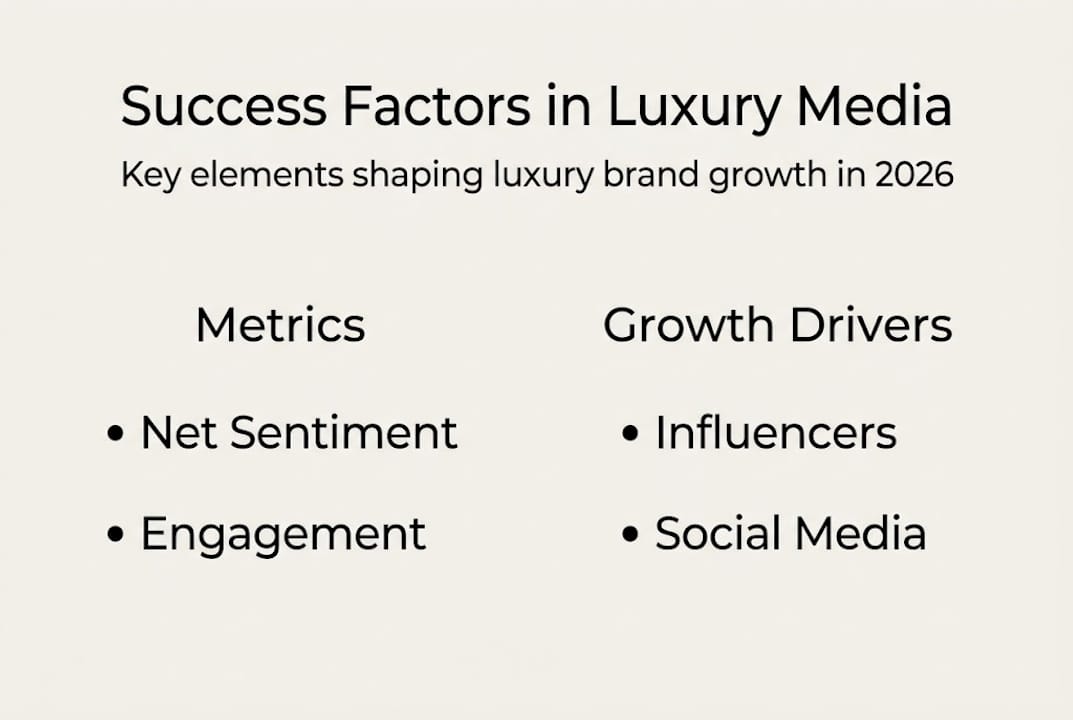
The L247 Luxury Brand Index operationalizes 13 digital variables across multi-platform net sentiment, engagement, and search metrics into a normalized composite score ranging from 0 to 1. That composite score gives brand managers a single, comparable number that reflects current market perception across the full digital landscape, not just one platform or one audience segment.

The five core variables you need to track continuously are:
| Metric | What it measures | Why it matters for luxury |
|---|---|---|
| Net sentiment | Ratio of positive to negative mentions | Indicates whether brand associations align with prestige positioning |
| Engagement rate | Interactions per post or piece of content | Signals emotional resonance with target audience |
| Search behavior | Volume and trend of branded search queries | Reflects active consumer interest and purchase intent |
| Reach | Total audience exposed to brand content | Measures visibility ceiling across channels |
| e-WOM (electronic word of mouth) | Volume and quality of organic brand mentions | Captures peer influence, the most credible signal in luxury |
The practical implication is clear: luxury brands need a living dashboard, not a quarterly report. Digital indicators can complement but not replace traditional brand equity tracking, because they provide timelier signals and mitigate the social desirability bias that distorts survey responses.
Pro Tip: Set automated alerts for sudden spikes or drops in net sentiment. A 20% negative sentiment spike within 48 hours is often an early warning of a PR issue that traditional tracking would catch weeks later. Catching it early gives you time to respond with precision rather than panic.
A well-structured luxury brand reputation management system incorporates these digital metrics as a continuous feedback loop, allowing teams to make real-time adjustments to messaging, channel investment, and influencer relationships without waiting for the next board presentation.
Attributes of media presence that drive luxury brand growth
With a framework for measuring digital presence, let’s focus on which attributes of media visibility actually drive luxury brand outcomes.
Not all media presence is equal. The fashion industry has learned this lesson repeatedly: a brand can dominate social conversation for all the wrong reasons. What separates visibility that builds brand equity from visibility that erodes it comes down to five specific attributes drawn from consumer engagement and e-WOM research: entertainment, interaction, trendiness, customization, and word of mouth.
Each of these attributes operates differently, and each requires a distinct approach in the luxury context:
- Entertainment: Luxury content must be aspirational and visually compelling. It should make the audience feel something, whether awe at craftsmanship, desire for the lifestyle, or pride in belonging to an exclusive community.
- Interaction: Two-way dialogue signals that a brand is alive and responsive. This does not mean replying to every comment casually. It means creating meaningful moments of engagement, polls around design choices, behind-the-scenes access, and live events that invite the audience in.
- Trendiness: Luxury brands walk a fine line here. Chasing trends destroys brand authority. Instead, the goal is to set micro-trends within your category while referencing broader cultural moments selectively and deliberately.
- Customization: Personalized communication outperforms generic broadcast in every measured category. At the content level, this means segmenting your audience by behavior and interest, not just demographics, and crafting messages that speak to specific motivations.
- Word of mouth: This is the multiplier. Content engineered to be shared, talked about, and referenced by peers carries far more weight than paid placements, especially in high-consideration luxury purchases.
| Factor | Traditional advertising | Interactive social media presence |
|---|---|---|
| Message control | High | Moderate |
| Audience trust | Lower | Higher |
| Speed of feedback | Weeks to months | Hours to days |
| Cost to scale | Very high | Moderate |
| e-WOM potential | Minimal | Significant |
| Personalization | Limited | High |
Building an optimized social media presence means choosing the right combination of these five attributes for each platform. What works on a visual-first platform differs dramatically from what resonates on a long-form editorial channel. The mistake most luxury teams make is applying a single creative strategy across every channel and wondering why engagement remains flat.
Pro Tip: Map each social platform to one or two dominant attributes. Use your most cinematic content for entertainment-led platforms, and reserve your personalization and interaction investments for channels where your highest-value customers are already active.
Leveraging influencers and partnerships to amplify media presence
Direct brand media is not the only velocity driver. Collaborations shape perception and build digital equity even faster.
Influencer and celebrity partnerships have become one of the most powerful tools available to luxury brand managers, but execution quality separates brands that grow from brands that simply spend. The multiplication effect is real: a single partnership with the right collaborator can extend your reach into a highly qualified audience segment that organic brand content would never reach efficiently.
Strategic influencer selection for luxury requires three filters working simultaneously. First, luxury fit: does this person’s aesthetic, values, and public reputation align with what your brand stands for? Second, audience overlap: are their followers the specific consumers you want to reach, not just a large number of followers with diffuse interests? Third, platform influence: does this collaborator actually drive behavior on the platforms where your brand needs visibility, not just vanity metrics?
Celebrity endorsement strategies that consistently outperform are built around emotional authenticity. When the partnership feels organic, meaning the influencer genuinely uses and understands the product, the e-WOM effect multiplies because the audience perceives it as a peer recommendation rather than a transaction.
Social media attributes that drive e-WOM including entertainment, interaction, and trendiness are most effective when they are co-created with partners rather than dictated to them. A brief given to an influencer should establish brand guardrails without scripting every sentence.
Key partnership dos and don’ts for luxury brands:
- Do co-create content with partners who understand luxury storytelling
- Do measure partnership impact using brand equity metrics, not just follower counts or likes
- Do pursue long-term ambassador relationships over one-off posts, since continuity builds credibility
- Don’t select partners based on follower volume alone; micro-influencers with 50,000 highly engaged luxury consumers often outperform mass-market figures with millions of followers
- Don’t ignore the comment section after a partnership post goes live; that is where real audience sentiment emerges
- Don’t allow a single collaboration to define your brand narrative, because diversified partnerships reduce dependency risk
Measuring partnership ROI through a brand equity lens means tracking net sentiment changes and search behavior spikes in the 30 to 60 days following activation. Luxury influencer collaboration examples consistently show that brands with a structured measurement protocol extract significantly more value from each partnership dollar than those relying on intuition alone.
A rigorous influencer partnerships approach documents the baseline equity score before activation, monitors digital variables weekly during the collaboration, and runs a post-campaign analysis to quantify which specific content formats drove the strongest brand equity gains. This data then informs the next partnership selection, turning a single campaign into a compounding learning asset. Refining your approach over multiple campaigns is exactly what separates a strong luxury influencer marketing program from a series of disconnected experiments.
A new luxury paradigm: Media presence as the highest form of brand value
Having detailed the tactics, let’s challenge some outdated assumptions and look at what’s next for luxury branding.
There is a persistent belief in the upper echelons of the fashion and luxury industry that the most prestigious brands whisper rather than shout. That mythology is appealing and, increasingly, dangerous. In a hyper-connected, algorithm-driven media environment, brands that whisper become invisible to new generations of affluent consumers who form their desires digitally before they form them in any other way.
The uncomfortable reality is that a brand with weaker products but stronger, smarter media presence will frequently outperform a brand with superior craftsmanship and poor digital visibility. We have already seen this pattern emerge in the luxury streetwear category and in the watch market among younger collectors. Heritage without presence is a slow erosion of relevance.
What most luxury leaders overlook is that media presence is not a byproduct of branding excellence. It is the branding. Every algorithm decision, every influencer activation, every piece of content, and every digital sentiment score is an act of brand building. Protecting and growing that presence with the same obsessive attention given to product quality is not a marketing department responsibility. It is a leadership mandate.
Future-proofing requires brand reputation strategies that are proactive, data-driven, and psychologically grounded. The brands that lead in 2026 and beyond will be those that treat media presence as their most valuable, most actively managed strategic asset.
Accelerate your luxury brand’s media presence with proven strategies
Ready to put these insights to work? Leverage the right tools and expertise to elevate your media presence.
Corrado Manenti works exclusively with fashion, luxury, and lifestyle brands that need more than generic marketing advice. His psychology-driven methodology translates consumer behavior insights into precise media strategies that build measurable brand equity. Whether you need a full digital presence audit, a tailored influencer playbook, or a step-by-step roadmap for positioning your brand as a category leader, the resources and consulting frameworks available at corradomanenti.it are built for exactly this challenge. Move from insight to execution with strategies designed for the highest standards of luxury brand management.
Frequently asked questions
How does media presence specifically impact luxury brand equity?
Media presence directly enhances luxury brand equity by increasing digital sentiment, engagement, and real-time awareness among target audiences. Research shows brands can evaluate digital brand equity through large-scale online consumer data including sentiment, reach, and search behavior.
What metrics are most important when measuring luxury brand media presence?
Net sentiment, engagement, multi-platform reach, and online search behavior are the most relevant and actionable metrics. The L247 Luxury Brand Index operationalizes 13 digital variables across these dimensions into a single normalized composite score.
Are digital indicators more useful than traditional brand equity tracking?
Digital indicators provide quicker, richer feedback and can complement traditional methods without fully replacing them in luxury branding. As research confirms, digital methods provide timelier signals and reduce the social desirability bias that distorts traditional surveys.
Which social media features drive engagement for luxury brands?
The most effective attributes are entertainment, interaction, trendiness, customization, and encouraging word of mouth. Engagement and e-WOM research confirms that brands leveraging all five attributes see stronger brand equity outcomes tied directly to purchase behavior.