


TL;DR:
- Cross-cultural branding requires adapting brand strategies while maintaining core identity to resonate locally.
- Failures like D&G’s China campaign highlight the importance of cultural sensitivity and vetting.
- Successful luxury brands build ongoing relationships with local cultures rather than relying on one-time campaigns.
When Mercedes-Benz entered the Chinese market, its brand name was inadvertently transliterated as “Bensi,” which loosely translates to “rush to die” in Mandarin. The story illustrates a hard truth: even the most prestigious brands can stumble badly when cultural context is treated as an afterthought. For luxury brand executives operating across borders, cross-cultural branding is not a peripheral concern. It is the strategic foundation that determines whether global expansion generates loyalty or provokes backlash. This guide unpacks what cross-cultural branding really means, shows how it plays out in the luxury sector, and gives you clear frameworks to apply it with precision.
Table of Contents
- What is cross-cultural branding and why does it matter?
- Classic wins and pitfalls: Lessons from luxury cross-cultural case studies
- Approaches: Balancing global brand identity and local relevance
- How to measure and scale cross-cultural branding success
- A new mindset for luxury: Culture as context, not a campaign
- Work with experts to future-proof your global luxury brand
- Frequently asked questions
Key Takeaways
| Point | Details |
|---|---|
| Cultural adaptation wins | Luxury brands using culturally adaptive strategies outpace competitors and avoid costly missteps. |
| Balance is key | Growth comes from blending global identity with authentic local resonance, not full standardization or localization. |
| Metrics matter | Success depends on tracking relationship quality and cultural relevance, beyond just sales data. |
| AI amplifies results | Advanced tools like AI and real-time listening enable luxury brands to adapt faster to cultural shifts. |
What is cross-cultural branding and why does it matter?
Cross-cultural branding goes far beyond hiring a translator or swapping out imagery for local tastes. At its core, cross-cultural branding means adapting brand strategies, messaging, products, and experiences to resonate with diverse cultural contexts while maintaining core brand identity. Practitioners often call this “glocalization,” a compact way of saying “think globally, act locally.”
For luxury brands, this distinction is especially sharp. A heritage house built on Parisian craftsmanship carries aspirational meaning in London, Shanghai, and Dubai. But the way that meaning is communicated, the symbols, the values, the social context, must shift depending on where the customer stands. Failing to make that shift with intelligence and sensitivity does not just cost sales. It can erode decades of brand equity in a matter of days.
There are several core tensions every luxury brand must manage:
- Consistency vs. relevance: A globally standardized identity signals authority and heritage, but can feel alien or even offensive in culturally distinct markets.
- Prestige vs. accessibility: Luxury must maintain aspiration while signaling understanding of local values, whether those are rooted in collective identity, family honor, or individual expression.
- Symbol and language: Colors, numbers, gestures, and idioms carry radically different connotations across cultures. What signals sophistication in one market can signal bad luck or disrespect in another.
- Experiential expectations: A VIP retail experience in Tokyo demands different cues than the same experience in Riyadh or São Paulo.
“Great luxury branding is not about where you come from. It is about whether the people you want to reach feel genuinely seen by you.”
The cultural influence in luxury goes beyond aesthetics. It shapes what customers believe the brand stands for, what social signals ownership sends, and whether they trust the brand enough to pay a premium repeatedly. Getting your luxury branding essentials right in one market is not a guarantee of success in another.
There is a spectrum in how brands approach this. Apple sits at one extreme, running a standardized approach for consistency and cost efficiency, with minimal localization. McDonald’s sits at the other end, engineering menus specifically for each market. For luxury, neither extreme alone works. A fully standardized Hermès feels globally coherent. A fully localized Hermès risks losing the French heritage that is the prestige. The answer, almost universally, is a disciplined glocalization framework, and learning from both wins and costly failures is the fastest route to building one. You can study what successful luxury rebranding looks like in practice to benchmark your own positioning.
Classic wins and pitfalls: Lessons from luxury cross-cultural case studies
Theory only takes you so far. The most instructive lessons come from real campaigns, brands that got it spectacularly right and those that paid a very high price for getting it wrong.
Failures that defined what not to do
The D&G China campaign in 2018 is one of the most studied cross-cultural disasters in luxury history. Dolce & Gabbana released a promotional video series featuring a Chinese model struggling to eat Italian food with chopsticks. The visual language communicated condescension, not celebration. Coupled with inflammatory leaked messages attributed to a co-founder, the backlash was immediate and severe. Chinese celebrities pulled out of a major Shanghai show. E-commerce platforms delisted the brand. The reputational damage took years to partially recover from.

The Hermès Ghibli-style animation, intended to connect with younger Asian consumers through playful storytelling, landed differently than planned. For many existing clients, the animated format clashed with the brand’s austere, heritage-driven identity and was perceived as reducing prestige rather than expanding relevance.
These failures share a common thread: well-intentioned executions that skipped rigorous local cultural vetting.
What success looks like
Compare those examples to luxury brands that took the time to understand symbolic language and social context deeply. Louis Vuitton’s collaboration with Japanese artist Takashi Murakami succeeded precisely because it honored Japanese aesthetic traditions from a place of genuine respect, not superficial borrowing. The brand acknowledged that fashion retail adaptation in Asia requires real cultural partnership, not just visual swaps.
| Marque | Approach | Outcome |
|---|---|---|
| Dolce & Gabbana (China 2018) | Stereotyped local culture in campaign | Widespread boycott, major revenue loss |
| Louis Vuitton x Murakami | Genuine artistic collaboration with local partner | Iconic crossover, major commercial success |
| Mercedes-Benz (China entry) | Phonetic transliteration without cultural check | Embarrassing brand name recall required |
| Burberry (China digital strategy) | Localized WeChat engagement and limited editions | Strong market growth and loyal local base |
The pattern is consistent. Brands that treat local culture as a partner in the creative process tend to earn loyalty. Brands that treat it as a backdrop for their existing campaigns tend to provoke backlash.
Key takeaways from these cases:
- Always vet visual, verbal, and conceptual choices with native cultural experts, not just translators
- Understand the local social hierarchy and how luxury status is signaled within it
- Test campaigns in smaller formats before committing to large-scale activations
- Monitor social media in the target language in real time during campaign launches
Pro Tip: Hiring a single bilingual consultant is not the same as deep cultural vetting. Build a small advisory panel of local consumers across age, gender, and social background. Their instinctive reactions will catch what an analyst might rationalize away.
For deeper analysis of premium branding case studies, particularly those involving prestige repositioning in new markets, the contrast between reactive and proactive cultural strategy becomes especially vivid.
Approaches: Balancing global brand identity and local relevance
With the case studies as context, the strategic question becomes practical: how do you actually structure a cross-cultural branding approach? The answer depends on where your brand sits on the standardization-to-localization spectrum and what your luxury positioning demands.
Three primary strategic approaches
-
Standardization: You maintain one consistent global identity, visual language, messaging, and product range. Apple is the most cited example. The brand’s minimalism travels well globally because it communicates modernity, technological leadership, and simplicity in a fairly universal language. For luxury, this works best when the brand’s prestige is itself the product, such as a heritage house whose French or Italian origin story is the core value.
-
Localization: You adapt deeply to each market, including products, communication style, and even brand values emphasis. McDonald’s famously engineers menus by country. In luxury, local editions and region-specific packaging can achieve something similar. The balance of global branding with local relevance is a recognized challenge that requires systematic frameworks, not guesswork.
-
Glocalization (the luxury sweet spot): You maintain the non-negotiables, heritage narrative, brand DNA, quality cues, and prestige signals, while adapting the expression of those values to local contexts. A watch brand can keep its Swiss origin story intact while presenting it through visual codes that resonate in Japan or the Gulf. This is not compromise. It is cultural fluency.
“Glocalization is not about watering down what you stand for. It is about translating what you stand for into a language the local market genuinely speaks.”
A practical decision framework
| Factor | Lean toward standardization | Lean toward localization |
|---|---|---|
| Brand heritage origin is the core asset | Yes | No |
| Target market has distinct symbolic language | No | Yes |
| Product range can flex without diluting prestige | No | Yes |
| Digital platform is market-specific (WeChat vs. Instagram) | No | Yes |
| Brand is early-stage in the new market | Partially | Partially |
Staying ahead of competitors in global luxury requires reviewing your luxury branding strategies regularly, not just at launch. Cultural expectations shift, generational values evolve, and what was locally resonant two years ago may need meaningful updating today. You can draw inspiration from innovation in luxury branding to understand how markets like Japan are redefining what prestige looks and feels like in 2026.
How to measure and scale cross-cultural branding success
Strategy without measurement is simply spending. For luxury brands operating across multiple cultural markets, the metrics you track reveal whether your cross-cultural branding is genuinely working or just aesthetically appealing to your internal team.
The numbers that matter
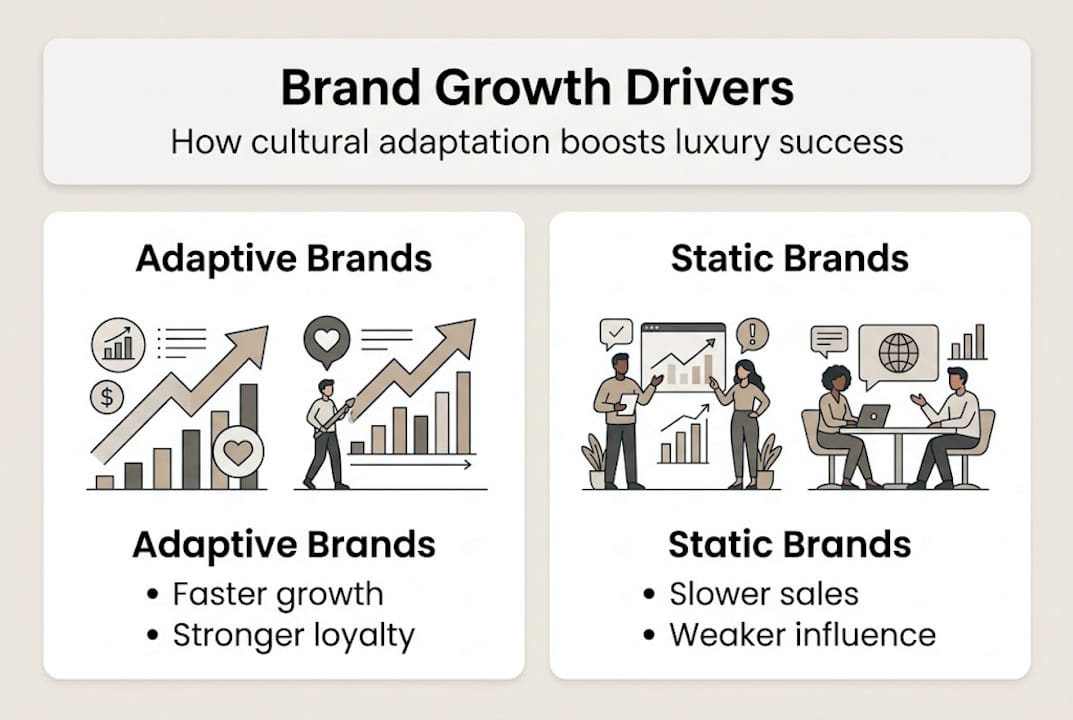
The evidence is clear: culturally adaptive brands grow faster. Brands with culturally adaptive strategies see 15% higher brand value growth according to McKinsey-cited research. Furthermore, 64% of consumers report engaging more with advertising that reflects cultural inclusion. Perhaps most striking for luxury market strategists: 65.56% of consumers actively prefer brands that engage with local cultures, not just local languages. In China specifically, luxury activations tied to cultural exhibitions drove a 59% surge in engagement in H1 2025. These are not marginal differences. They represent compounding advantages that widen over time.
What you should actually measure
Most luxury brand executives default to sales velocity and revenue as primary performance indicators for new market activations. Sales matter, of course. But for cross-cultural branding, relationship quality metrics give you a far richer picture of whether your brand is building durable equity or just riding a temporary novelty wave.
Consider tracking:
- Cultural resonance score: Periodic surveys measuring how strongly local consumers associate your brand with their own values and cultural identity
- Local loyalty index: Repeat purchase rate and referral behavior from culturally distinct segments
- Social sentiment in native language: What people are saying about your brand in Mandarin, Arabic, Japanese, or Korean, not just what they say in English
- Engagement depth: Time spent with branded content, not just impressions or clicks
- Brand love indicators: Unsolicited brand advocacy, user-generated content, and organic association with locally valued symbols or occasions
AI and social listening as your real-time sensors
AI-driven consumer insights have fundamentally changed what is possible in cross-cultural brand monitoring. Sophisticated social listening tools can now detect sentiment shifts, emerging slang associations, and nuanced cultural conversations happening around your brand in real time, across languages and platforms. This allows luxury marketing teams to identify a brewing cultural misalignment before it becomes a crisis, and to spot emerging local trends before competitors do.
The key growth markets of China, Japan, and the Middle East each have their own dominant platforms, cultural codes, and luxury consumption rituals. AI monitoring calibrated to those specific ecosystems is no longer a competitive edge. It is a baseline requirement. Combine AI tools with emotional branding strategies to convert cultural resonance into long-term consumer loyalty.
Pro Tip: Set at least three KPIs per market that have nothing to do with direct sales. Brand love, cultural fluency scores, and local community engagement signal the health of your long-term position far more accurately than quarterly revenue alone.
A new mindset for luxury: Culture as context, not a campaign
Here is the uncomfortable truth most luxury brands are not yet ready to hear: cross-cultural branding done well is not a campaign. It is not a Chinese New Year activation or a Ramadan collection. Those are cultural moments, and they matter. But brands that treat them as their entire cross-cultural strategy are essentially tourists visiting a country they do not live in.
Real cultural engagement is ongoing. It is built through years of listening, co-creating, and genuinely learning from local markets. The luxury brands that will dominate the next decade will be those that build internal cultural intelligence, not just hire external agencies to execute seasonal activations.
This requires a kind of organizational humility that is rare in prestigious legacy houses. It means accepting that your global creative director does not automatically understand what resonates in Osaka or Riyadh. It means investing in local talent at the decision-making level, not just in execution roles. Revisiting branding mindsets in luxury periodically is one way to pressure-test whether your approach is evolving or calcifying.
Culture is always moving. Consumer values are shifting in every market. The brands that build continuous learning loops, informed by real relationships and real data, will earn the kind of cross-cultural loyalty that no campaign budget alone can buy.
Work with experts to future-proof your global luxury brand
Navigating cross-cultural branding at the level of precision that luxury demands is genuinely difficult work. The strategic frameworks above will get you oriented, but execution at a high level requires someone who understands both the psychological drivers behind luxury purchasing and the nuanced differences between global markets.
Corrado Manenti’s consulting practice is built precisely for this challenge, combining deep psychological insight with hands-on luxury market expertise. Whether you are developing luxury market growth tactics for a new regional expansion, rethinking your brand architecture through luxury rebranding consulting, or using the luxury brand checklist to audit your current positioning, the goal is the same: measurable, culturally intelligent brand growth that protects your prestige while expanding your global reach.
Frequently asked questions
What are some examples of cross-cultural branding failures in luxury?
Notable failures include the D&G China campaign which triggered major boycotts through cultural stereotyping, and Mercedes-Benz’s unintended Chinese name transliteration that required brand correction. Both cases show how quickly cultural missteps erode prestige.
How is ‘glocalization’ applied by luxury brands?
Glocalization in branding means keeping your global brand DNA intact while adapting its expression to local cultural codes, such as limited-edition products, locally resonant events, or platform-specific digital strategies that align with local consumer behavior.
Why is cross-cultural branding more complex for luxury brands?
Luxury brands must protect the very exclusivity and heritage that constitute their core identity while making that identity feel locally meaningful, a far narrower creative and strategic corridor than mass market brands operate within.
What are the best markets for luxury cross-cultural growth in 2026?
China, Japan, and the Middle East are the key growth engines for luxury cross-cultural branding in 2026, each offering distinct consumer profiles, platform ecosystems, and cultural purchasing rituals that reward well-adapted luxury strategies.
How can AI help optimize cross-cultural luxury branding?
AI and social listening tools detect emerging cultural nuances, sentiment shifts, and brand associations in real time and in local languages, enabling luxury brands to adapt messaging proactively and prevent cultural missteps before they escalate.