


Luxury consumers are 78% more likely to trust brands exhibiting meticulous attention to detail, yet many brand managers focus solely on big messaging while overlooking subtle elements that drive emotional connection. This oversight costs premium brands loyal customers and market share. Understanding how detail-oriented branding elevates luxury brands’ emotional resonance and commercial success transforms good marketing into exceptional brand experiences that command premium pricing and deep customer loyalty.
Table of Contents
- The Role Of Detail In Luxury Branding: Foundations And Importance
- Consumer Psychology: How Details Shape Emotional Connections
- Mechanisms: Why Detail Creates Lasting Brand Impressions
- Common Misconceptions: What Most Get Wrong About Detail In Branding
- Framework Comparison: Balancing Macro Narrative With Micro Detail
- Implementing Detail-Focused Branding Strategies: The Role Of Innovation
- Case Studies: Detail-Driven Branding Success Stories
- Summary And Actionable Takeaways For Brand Managers
- Enhance Your Luxury Brand With Expert Detail-Driven Strategies
- Frequently Asked Questions
Key takeaways
| Point | Details |
|---|---|
| Meticulous detail creates trust | 78% of luxury consumers trust detail-focused brands more than those neglecting micro-elements. |
| Psychology amplifies emotional attachment | Emotionally aligned details boost brand equity by 60% through subconscious trust signals. |
| Balance drives superior engagement | Brands balancing macro storytelling with micro details achieve 32% higher customer engagement. |
| Digital innovation enables precision | 75% of luxury consumers expect personalized digital experiences that manage fine details seamlessly. |
| Neglecting details risks dilution | Inconsistent branding elements fragment consumer experience and erode premium brand perception. |
The role of detail in luxury branding: foundations and importance
Consumers in luxury sectors demand impeccable quality and consistency across every brand touchpoint. From typography choices to packaging textures, these elements create multi-sensory experiences that separate premium brands from mass market competitors.
Attention to sensory elements fosters emotional engagement that transcends rational purchase decisions. Visual harmony, tactile quality, and even scent signatures work together to create memorable brand encounters. When executed consistently, these details become synonymous with the brand itself, triggering instant recognition and positive associations.
Understanding the role of detail in luxury branding reveals how consistent micro-elements build differentiation in crowded markets. Consider these foundational pillars:
- Visual consistency across all materials reinforces brand identity subconsciously
- Tactile quality signals premium positioning without explicit messaging
- Cohesive sensory experiences create emotional anchors that drive repeat purchases
- Detail precision demonstrates brand respect for customer intelligence and taste
Ignoring detail leads to fragmented brand experiences that confuse consumers and dilute premium perception. A luxury automotive brand using inconsistent leather stitching patterns or a fashion house with variable packaging quality sends mixed signals about their commitment to excellence.
“Every detail either reinforces or undermines your brand promise. There is no neutral ground in luxury markets where consumers scrutinize every element as evidence of your commitment to quality.”
This scrutiny explains why successful luxury brands obsess over elements most consumers cannot consciously articulate. The cumulative effect of perfect details creates an intangible sense of rightness that justifies premium pricing and builds unshakeable brand loyalty.
Consumer psychology: how details shape emotional connections
Emotional attachment increases by 60% when branding details align perfectly with luxury ideals and consumer aspirations. This dramatic lift stems from psychological mechanisms that operate below conscious awareness, making detail orientation a powerful tool for building lasting relationships.
Psychologically informed details provide subconscious cues that foster trust and desire simultaneously. When a luxury watch brand maintains perfect consistency in crown knurling depth or a fashion house uses identical button weight across collections, consumers absorb these signals as evidence of broader organizational excellence.
Subtle sensory branding elements influence 56% of luxury purchase decisions, often without buyers realizing why they prefer one brand over another. This unconscious processing makes detail management more powerful than overt marketing messages:
- Consistent visual rhythms create cognitive ease that feels like brand affinity
- Precise tactile feedback triggers pleasure centers associated with quality assessment
- Harmonious sensory experiences build neural pathways linking your brand to positive emotions
- Detail perfection signals competence and reliability across all business operations
Leveraging consumer psychology enables deeper, lasting brand loyalty that survives market fluctuations and competitive pressure. Customers bonded through detail-driven experiences become brand advocates who resist switching even when offered lower prices elsewhere.
Pro Tip: Audit your brand touchpoints for sensory consistency. Record how materials feel, sound, and smell at customer interaction points. Inconsistencies here undermine months of marketing investment by creating subconscious doubt about your commitment to excellence.
This psychological foundation explains why detail orientation delivers returns far exceeding its implementation costs. Small investments in consistency yield exponential gains in customer lifetime value and brand equity.
Mechanisms: why detail creates lasting brand impressions
Consistency in small branding elements like typography spacing, logo placement precision, and packaging corner construction builds subconscious trust that conscious marketing cannot replicate. These micro-details create pattern recognition that becomes synonymous with your brand identity.

Micro-detail consistency correlates with 23% higher brand recall among premium segment consumers who process hundreds of brand messages daily. This advantage compounds over time as consistent details reinforce memory structures that make your brand the default choice.
Inconsistent details risk producing brand dilution that erodes premium positioning faster than price cuts. When packaging quality varies between product lines or digital experiences feel disconnected from physical retail, consumers question whether your brand truly deserves its premium pricing.
Higher brand recall from detail consistency drives competitive advantage that protects market share during economic downturns. Consumers remember brands that respect their intelligence enough to perfect every element, creating loyalty that transcends rational cost-benefit analysis.
Detail consistency complements overall brand narrative for maximum impression. Consider these mechanism layers:
- Repetition of precise details creates neural pathways that trigger instant brand recognition
- Sensory consistency reduces cognitive load, making brand interactions feel effortless
- Perfect execution signals organizational competence across all business functions
- Unified micro-elements create holistic experiences greater than individual touchpoints
Implementing a luxury branding checklist ensures no detail escapes scrutiny during brand development and refresh cycles. Systematic attention prevents the gradual drift that undermines premium positioning.
“Brand recall operates at the intersection of conscious memory and subconscious pattern recognition. Details create the patterns that make your brand unforgettable, even when consumers cannot articulate why they remember you so vividly.”
This recall advantage translates directly into market share gains as consumers default to familiar brands during purchase decisions. The cumulative effect of consistent details becomes an insurmountable competitive moat.
Common misconceptions: what most get wrong about detail in branding
Many brand managers believe only major elements like logos and taglines drive consumer decisions. This myth persists despite overwhelming evidence that subtle details exert equal or greater influence on purchase behavior and brand perception.
Reality contradicts this assumption. Subtle details have significant influence, often determining whether consumers perceive your brand as genuinely premium or merely expensive. A luxury fashion brand with perfect advertising but inconsistent button placement telegraphs deeper organizational problems that savvy consumers detect instinctively.
Another prevalent myth suggests price is the primary luxury purchase driver over branding details. Markets prove otherwise. Detail quality often outweighs price perception in premium segments where consumers willingly pay more for brands demonstrating total commitment to excellence.
The most damaging misconception treats details as nice-to-have enhancements rather than critical success factors. Reality reveals that neglecting details leads directly to brand dilution and lost loyalty as consumers migrate toward competitors who respect their sophistication.
Address these misconceptions systematically:
- Audit every customer touchpoint for detail consistency, not just flagship products
- Measure consumer response to micro-element changes through A/B testing
- Track correlation between detail investments and customer lifetime value metrics
- Document how detail improvements affect brand perception scores over time
- Compare your detail standards against category leaders, not just direct competitors
Pro Tip: Create a detail deviation log tracking every instance where brand standards were compromised. Review quarterly to identify patterns and systemic weaknesses. This simple practice prevents gradual quality erosion that consumers notice before management does.
Correcting these misconceptions transforms branding effectiveness by redirecting resources toward high-impact detail improvements that compound over time.
Framework comparison: balancing macro narrative with micro detail
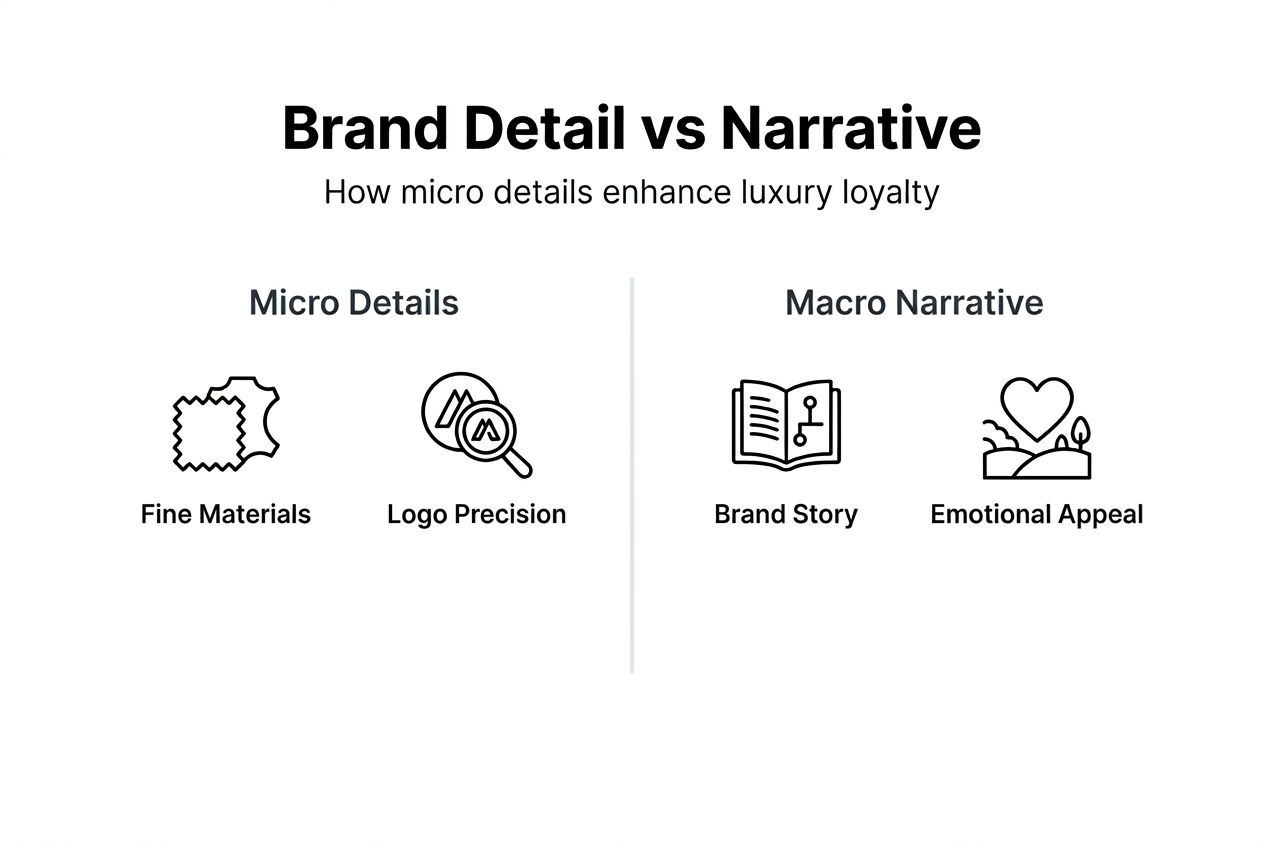
Macro narrative drives broad emotional appeal through storytelling that connects brand values to consumer aspirations. This big-picture approach creates meaning and context that justifies premium positioning and builds initial brand awareness.
Micro details generate sensory engagement and premium differentiation that macro narratives alone cannot deliver. Perfect execution of small elements provides tangible proof that your brand story reflects operational reality rather than marketing fantasy.
Over-focusing on either narrative or detail exclusively reduces overall impact and leaves competitive vulnerabilities. Brands emphasizing only grand storytelling risk seeming hollow when execution falters. Conversely, detail perfection without compelling narrative feels soulless and fails to inspire emotional connection.
Brands balancing macro narrative with micro-detail elements have 32% higher customer engagement than those focusing solely on big-picture branding. This synergy creates experiences where story and execution reinforce each other seamlessly.
| Approach | Strengths | Weaknesses | Best Application |
|---|---|---|---|
| Macro Narrative Focus | Builds emotional resonance and brand meaning | Risks hollow perception without execution proof | Brand launches and repositioning campaigns |
| Micro Detail Focus | Demonstrates competence and premium quality | Can feel cold without emotional context | Product excellence and operational marketing |
| Balanced Synergy | Maximizes recall, loyalty, and engagement | Requires more resources and coordination | Mature luxury brands defending market position |
Implementing balanced approaches requires understanding psychology in luxury branding to identify which details matter most to your specific audience. Not all micro-elements carry equal weight in consumer perception.
Balanced strategy implementation follows these principles:
- Develop narrative frameworks that naturally highlight detail excellence
- Choose details that embody your brand story’s core values
- Create feedback loops where consumer detail responses inform narrative evolution
- Train teams to see connections between story elements and execution standards
This framework transforms branding from either/or choices into synergistic systems where every element amplifies others. The result is brand experiences that feel both meaningful and flawlessly executed.
Implementing detail-focused branding strategies: the role of innovation
75% of luxury consumers expect personalized digital brand experiences that adapt to individual preferences while maintaining brand consistency. This expectation creates opportunities for brands willing to leverage emerging technologies for detail management.
AR and AI enable immersive, customizable detail management that was impossible in traditional luxury marketing. Augmented reality lets customers visualize how product details suit their personal style before purchase, while artificial intelligence maintains brand consistency across millions of personalized interactions.
Digital tools help monitor, refine, and scale consistent branding details across global operations. Cloud-based brand management systems ensure that a boutique in Tokyo delivers identical detail quality as locations in Milan or New York, eliminating geographic inconsistency.
Innovation raises the standard for detail orientation and customer engagement by making previously impossible precision achievable at scale. Brands adopting these tools gain competitive advantages that traditional approaches cannot match.
Implement innovation strategically:
- Deploy AI systems to monitor detail consistency across digital and physical touchpoints
- Use AR to let customers explore product details in immersive environments
- Implement machine learning to personalize experiences while preserving brand identity
- Adopt blockchain for supply chain transparency that proves detail quality claims
- Integrate IoT sensors in physical retail to ensure environmental details match brand standards
Explore digital innovation in luxury approaches that enhance rather than replace human craftsmanship. Technology should amplify your commitment to detail, not substitute for it.
Pro Tip: Start digital innovation pilots in controlled environments before full deployment. Test whether technology enhances detail perception or creates new friction points. Luxury consumers punish brands that prioritize digital novelty over seamless experiences.
Understanding the role of detail in luxury branding helps identify which innovations genuinely serve customer needs versus those that merely showcase technical capability. Focus innovation investments where they amplify detail excellence most effectively.
Case studies: detail-driven branding success stories
A European automotive luxury brand refined micro-details in customer touchpoints, from showroom lighting temperatures to service appointment confirmation typography. This comprehensive detail enhancement boosted sales by 15% within eight months as customers perceived dramatically elevated brand commitment.
A luxury fashion label increased repeat customer rate by 40% through systematic detail improvements across packaging, digital communications, and in-store experiences. The brand discovered that consistent button weight across all garments created subconscious quality signals that drove repurchase behavior.
Cross-industry examples highlight detail as a universal driver of premium brand growth regardless of product category. Whether automotive engineering, fashion craftsmanship, or lifestyle curation, detail excellence translates directly into commercial success.
Key lessons from successful implementations:
- Small detail changes compound into significant perception shifts over time
- Consumers notice and reward brands that perfect elements competitors ignore
- Detail investments yield higher ROI than traditional advertising in luxury segments
- Systematic approaches outperform sporadic excellence in building lasting loyalty
Study fashion brand growth tactics that prioritize detail consistency as competitive differentiation. These proven approaches transfer across luxury categories with appropriate customization.
These case studies demonstrate that detail orientation is not theoretical marketing philosophy but practical strategy with measurable business impact. Brands committed to micro-element excellence consistently outperform competitors in customer acquisition, retention, and lifetime value metrics.
Summary and actionable takeaways for brand managers
Consolidate these insights into clear next steps that elevate luxury brand identity through detail-focused strategies. Successful implementation requires systematic approaches rather than sporadic attention to isolated elements.
Understand and audit micro-details across all brand touchpoints, from digital interfaces to physical packaging and customer service scripts. Create comprehensive inventories identifying every element contributing to brand perception, then evaluate each for consistency and quality.
Leverage consumer psychology to prioritize impactful details that create subconscious trust and emotional attachment. Not all details carry equal weight, so focus resources where psychological research indicates maximum return.
Balance macro narrative with micro detail for maximum engagement by ensuring your brand story and execution quality reinforce each other. Stories without flawless delivery feel empty, while perfect execution without meaning feels cold.
Adopt digital innovation for personalized detail management that maintains brand consistency across millions of individual interactions. Technology enables previously impossible precision at global scale.
Monitor and continuously refine branding details based on consumer feedback and competitive evolution. Detail standards that differentiate today become table stakes tomorrow, requiring constant elevation.
Implement these steps systematically:
- Conduct comprehensive detail audits across all customer touchpoints quarterly
- Establish detail consistency standards with measurable compliance metrics
- Train all team members to recognize how their work affects brand detail perception
- Invest in technology that scales detail management without sacrificing quality
- Create feedback mechanisms capturing consumer detail perceptions before problems escalate
- Benchmark your detail standards against category leaders, not just competitors
- Allocate budget specifically for detail improvements separate from major campaigns
Reference your luxury branding checklist regularly to ensure no critical element escapes systematic review. Checklists prevent the oversight that undermines months of branding investment.
These actionable steps transform detail orientation from aspirational goal into operational reality that drives measurable business results.
Enhance your luxury brand with expert detail-driven strategies
Transforming your brand through meticulous detail requires specialized expertise combining psychology, luxury market knowledge, and digital innovation. Generic marketing approaches miss the nuances that separate good luxury brands from exceptional ones that command premium loyalty.
Explore proven fashion brand growth tactics for the luxury market that systematically enhance detail consistency across all brand touchpoints. These frameworks help you identify high-impact improvements that deliver measurable results quickly.
Leverage digital innovation in luxury to manage details at scale while maintaining the human touch that luxury consumers expect. Technology should amplify your commitment to excellence, not replace craftsmanship.
Access comprehensive resources including a checklist for luxury branding that ensures systematic attention to every detail influencing brand perception. Professional guidance accelerates implementation while avoiding costly missteps that damage premium positioning.
Frequently asked questions
Why is attention to detail vital in luxury branding?
Detail fosters trust and premium perception by meeting luxury consumer expectations for flawless execution across every touchpoint. Consistent sensory and visual details build emotional bonds and brand recall that transcend rational purchase decisions. Ignoring details risks brand dilution and lost customer loyalty as consumers interpret inconsistency as evidence of broader organizational problems.
How can digital innovation improve detail management in branding?
AI and AR enable immersive, personalized brand experiences that manage fine details precisely across millions of individual interactions. Digital tools aid continuous refinement and consistency in luxury branding by monitoring touchpoints in real time and alerting teams to deviations before consumers notice problems.
What common mistakes do brand managers make regarding branding details?
Ignoring subtle sensory and visual details beyond logos and messaging represents the most frequent oversight, despite research showing these elements drive 56% of purchase decisions. Focusing too much on big-picture storytelling at the expense of consistency creates perception gaps between brand promise and delivery. Failing to adopt digital personalization tools for managing details leaves competitive advantages on the table.
How do details influence consumer purchase decisions in luxury markets?
Studies show 56% of luxury purchase decisions are influenced by brand details that operate below conscious awareness, triggering subconscious quality assessments. Details create neural triggers that elevate perceived quality and desire by signaling organizational competence and commitment to excellence that justifies premium pricing.