TL;DR:
- Trust is essential for loyalty in luxury markets, surpassing product quality.
- Building trust involves authenticity, transparency, emotional experiences, and technological verification.
- Trust enhances brand value, justifies premium pricing, and requires consistent, genuine efforts to maintain.
Most luxury brand leaders believe that if the product is exceptional enough, loyalty will follow. That assumption is expensive. In premium fashion and lifestyle markets, product quality is the price of entry, not the source of loyalty. What actually keeps high-value clients coming back, advocating, and resisting competitor offers is something far less tangible and far more powerful: trust. Research confirms that luxury brand loyalty is built on psychological factors like exclusivity, heritage, emotional connection, and consistency rather than product quality alone. This guide unpacks how trust is built, maintained, and sometimes lost in premium branding, and what you can do about it.
Table of Contents
- Why trust, not just quality, is the loyalty engine
- Building trust: Core pillars for premium brands
- How trust amplifies value and justifies premium pricing
- Maintaining and repairing trust in luxury: Pitfalls and best practices
- Perspective: Why trust is the most undervalued luxury brand asset
- Accelerate your brand loyalty with proven luxury strategies
- Frequently asked questions
Key Takeaways
| Point | Details |
|---|---|
| Trust fuels loyalty | Long-term premium brand loyalty is driven more by trust than by quality or exclusivity alone. |
| Multidimensional strategies | Heritage, authenticity, and consistency across experiences are crucial to building trust in luxury brands. |
| Premium pricing power | Strong trust allows luxury brands to justify and sustain higher price points in competitive markets. |
| Proactive crisis response | Swift, transparent action is vital for repairing trust if it is damaged in the premium sector. |
Why trust, not just quality, is the loyalty engine
Quality is expected in luxury. When a client pays for a handcrafted leather bag or a bespoke suit, flawless execution is the baseline. The real question is: why do some clients return for decades while others, equally impressed by the product, quietly drift to a competitor? The answer almost always comes back to trust.
Trust in premium branding is not a single feeling. It is a layered psychological state shaped by exclusivity, perceived heritage, emotional resonance, and the consistency of every interaction a consumer has with the brand. When those layers align, loyalty becomes nearly automatic. When even one layer cracks, the whole structure weakens faster than most brand managers expect.
Empirical research supports this directly. Brand experiences drive brand love, trust, and loyalty in measurable, positive ways, with each positive touchpoint compounding the effect. This means every client interaction, from the in-store greeting to the unboxing moment, is either building or eroding the trust architecture your brand depends on.
| Driver | Impact on loyalty | Neglect risk |
|---|---|---|
| Heritage and provenance | High | Brand feels generic |
| Emotional connection | Very high | Clients switch easily |
| Consistency of experience | High | Trust erodes quickly |
| Product quality | Moderate | Table stakes only |
Common pitfalls emerge when brands treat trust as a byproduct of quality rather than an active strategy. Over-reliance on product innovation, inconsistent service standards across markets, and opaque supply chains all signal untrustworthiness to sophisticated luxury consumers. You can read more about trust in luxury customer loyalty and how storytelling for luxury trust plays a direct role in building that psychological foundation.
“Trust is not given to luxury brands. It is earned through every decision, every detail, and every promise kept over time.”
The brands that lead in loyalty are not always the ones with the best products. They are the ones that have made trust a deliberate, managed asset.
Building trust: Core pillars for premium brands
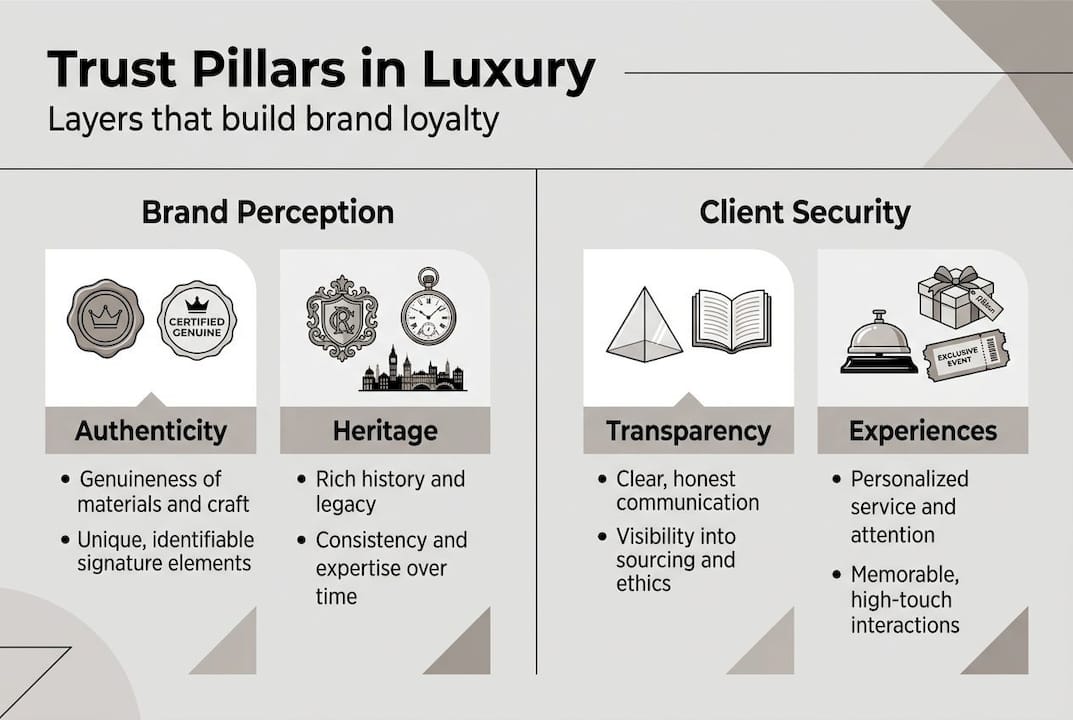
Understanding why trust matters is one thing. Knowing how to build it systematically is where most brands fall short. Leading luxury houses do not leave trust to chance. They engineer it across four core pillars.
1. Authenticity and heritage
Consumers are sophisticated. 60% of luxury consumers link authenticity directly to heritage, and that connection is not nostalgic sentiment. It is a trust signal. When a brand can articulate where it comes from, what it stands for, and why its craft matters, it creates an institutional credibility that no marketing budget can manufacture overnight. Heritage and brand prestige are deeply intertwined, and brands that invest in communicating provenance consistently outperform those that do not.
2. Transparency and ethical practice
The new luxury consumer researches before they buy. They want to know where materials come from, how workers are treated, and whether sustainability claims are real or performative. Brand authenticity directly increases consumer trust and purchase intentions in sustainable luxury, with trust acting as a partial mediator. Brands that practice transparency in luxury are not just being ethical. They are making a strategic trust investment.
3. Experiential and emotional touchpoints
Every sensory and emotional moment a client experiences with your brand is a trust deposit or withdrawal. The scent of a flagship store, the weight of a shopping bag, the tone of a follow-up message: these details accumulate into a felt sense of reliability. Art and authenticity in luxury experiences show how emotional resonance creates the kind of brand connection that outlasts any single product cycle.
4. Technology for transparency
Blockchain for supply chain verification, AR for product authentication, and digital provenance records are no longer futuristic. They are active trust tools. Brands using these technologies give clients verifiable proof of the claims they make, which is the highest form of trust-building available today.
Pro Tip: Map every client touchpoint against your core trust pillars. If a touchpoint cannot reinforce at least one pillar, redesign it. Coherence across the entire journey is what separates trusted brands from merely admired ones. For a strong narrative for trust, every channel must speak the same language.
| Pillar | Traditional approach | Trust-optimized approach |
|---|---|---|
| Authenticity | Brand history on website | Provenance storytelling across all channels |
| Transparency | CSR report | Real-time supply chain visibility |
| Experience | In-store service | Consistent omnichannel emotional journey |
| Technology | E-commerce | Blockchain verification, AR authentication |
How trust amplifies value and justifies premium pricing
There is a direct financial argument for trust, and it is one that brand managers should be making in every boardroom conversation about pricing strategy. Trust does not just feel good. It multiplies brand equity and makes premium pricing defensible over the long term.
Strong brand equity built on reputation, perceived value, and consistent image fosters both trust and loyalty, and 80.9% of respondents in one study agreed that brand reputation directly influences their purchase decisions. That is not a marginal effect. It is a structural advantage that trusted brands hold over competitors who rely on product differentiation alone.
When clients trust a brand, price sensitivity drops. They are not comparing your product to a competitor’s on a features-and-price matrix. They are buying into a relationship, a set of values, and a promise of consistent excellence. That psychological shift is worth more than any promotional discount strategy.
| Brand equity component | Effect on trust | Effect on pricing power |
|---|---|---|
| Reputation | Builds institutional credibility | Supports premium price floor |
| Perceived value | Elevates emotional worth | Reduces price comparison behavior |
| Consistent experience | Reinforces reliability | Increases repeat purchase rate |
| Brand image | Creates aspirational identity | Attracts new high-value clients |
The business outcomes of strong brand trust include:
- Higher client retention rates without relying on loyalty programs or discounts
- Stronger word-of-mouth advocacy, which is the most credible form of luxury marketing
- Greater resilience during market downturns, as trusted brands retain clients when spending tightens
- Faster recovery from product missteps, because the trust reserve absorbs short-term failures
- Expanded pricing latitude, allowing brands to introduce new price tiers without losing core clients
Explore how aspirational branding in luxury and experiential luxury branding compound these effects when built on a trust foundation.
Maintaining and repairing trust in luxury: Pitfalls and best practices
Trust is powerful, but it is also asymmetric. It takes years to build and can be damaged in a single news cycle. Premium brands are especially vulnerable because their clients hold them to a higher standard. The expectation gap between what luxury promises and what it delivers is where trust failures live.
One misstep, whether it is inconsistency in service quality, a greenwashing scandal, or a supply chain controversy, can erode years of carefully built equity. This is not hypothetical. Several major luxury houses have experienced exactly this, watching brand perception scores drop sharply after a single public incident.
When trust is damaged, the recovery process requires a structured approach:
- Acknowledge immediately. Silence is interpreted as guilt. A fast, honest acknowledgment limits the narrative damage before it compounds.
- Take full responsibility. Partial admissions or deflections read as inauthentic, which deepens the trust wound rather than healing it.
- Communicate the corrective action. Clients need to see a concrete plan, not just an apology. Specificity signals seriousness.
- Demonstrate change over time. Trust is rebuilt through consistent behavior, not announcements. Set a timeline and report against it.
- Re-engage through experiential moments. Invite affected clients back into the brand experience through exclusive, personalized touchpoints that reaffirm the relationship.
Affective commitment influenced by trust and social switching costs enhances both consumption satisfaction and advocacy, meaning that clients who are emotionally committed to a brand are more forgiving when trust is repaired genuinely.
Pro Tip: The most common mistake brands make during trust repair is over-communicating promises and under-delivering on follow-through. Set conservative commitments and exceed them. Every kept promise during a recovery period is worth ten times the trust value of a normal kept promise.
“In luxury, trust is not a campaign. It is a commitment that must survive every test the market throws at it.”
Strategies like reinforcing boosting brand prestige with heritage and doubling down on luxury brand transparency are the fastest routes back to solid ground after a trust event.
Perspective: Why trust is the most undervalued luxury brand asset
After working across premium fashion and lifestyle brands, one pattern stands out clearly: the brands that struggle most with loyalty are not the ones with inferior products. They are the ones that confused mystique with trust.
Mystique is a performance. Trust is a relationship. You can manufacture mystique with scarcity tactics, celebrity partnerships, and carefully controlled imagery. You cannot manufacture trust. It accumulates through hundreds of small, consistent decisions made over time, and it evaporates the moment clients sense a gap between what you project and what you deliver.
The uncomfortable reality is that too many premium brands still invest more in image management than in the operational and cultural foundations that make trust possible. The new generation of luxury buyers is different. They scrutinize provenance. They research supply chains. They notice when a brand’s values are marketing copy rather than lived practice.
The reframe I encourage every brand leader to make is this: stop asking “how do we look?” and start asking “how reliable are we?” Brand storytelling’s impact is only as strong as the truth behind the story. When the story and the reality align, trust compounds. When they diverge, no amount of creative execution saves you.
Accelerate your brand loyalty with proven luxury strategies
Trust is not a soft concept. It is the most durable competitive advantage a premium brand can hold, and it requires the same strategic rigor you apply to product development or pricing. The frameworks in this guide give you a foundation, but applying them effectively demands both psychological insight and luxury market expertise.
If you are ready to move from understanding trust to actively engineering it across your brand, the resources and consulting support at Corrado Manenti expertise are built specifically for premium fashion and lifestyle brands. Explore luxury growth tactics that translate trust principles into measurable loyalty outcomes, and discover how experiential branding advantages can become your most powerful trust-building tool. The next step toward unshakeable brand loyalty starts here.
Frequently asked questions
What are the main factors that build trust in premium brands?
Heritage, authenticity, and consistency are the core trust drivers in luxury, alongside brand authenticity which directly increases consumer trust and purchase intentions. Exceptional experiences and transparent practices reinforce all of these factors.
How does trust affect premium pricing for luxury brands?
Trust raises perceived brand value and reputation, which reduces price sensitivity among loyal clients. Strong brand equity built on trust directly justifies and sustains premium pricing over time.
What should brands do if trust is damaged?
Act fast, take full responsibility, and communicate a concrete corrective plan. One misstep can erode years of equity, so the speed and authenticity of the response are critical to limiting long-term damage.
How do brand experiences influence trust in luxury markets?
Brand experiences drive measurable increases in brand trust and customer loyalty, with every positive touchpoint compounding the effect. Consistent, emotionally resonant experiences are among the most powerful trust-building tools available to luxury brands.