


TL;DR:
- Brand equity is a valuable asset driven by consumer perception, trust, and emotional connections, crucial for luxury brands’ profitability. Investing in brand equity enhances pricing power, reduces customer acquisition costs, and builds long-term consumer loyalty. Focusing on strategic measurement and consistent reputation management ensures that brand equity remains a competitive advantage and a key driver of sustained growth.
Brand equity is the measurable value derived from consumer perception, trust, and emotional association with a brand, making it one of the most powerful financial assets a luxury business can hold. For executives and marketing leaders in high-value sectors, understanding why brand equity is crucial goes far beyond abstract reputation management. Research from Brand Finance, NielsenIQ, and SKIM confirms that brand equity directly drives pricing power, customer loyalty, and long-term profitability. Brands that treat equity as a capital asset consistently outperform those that optimize only for short-term conversion. The difference shows up in margins, retention rates, and the ability to hold price under competitive pressure.
Why brand equity is crucial for pricing power and profit
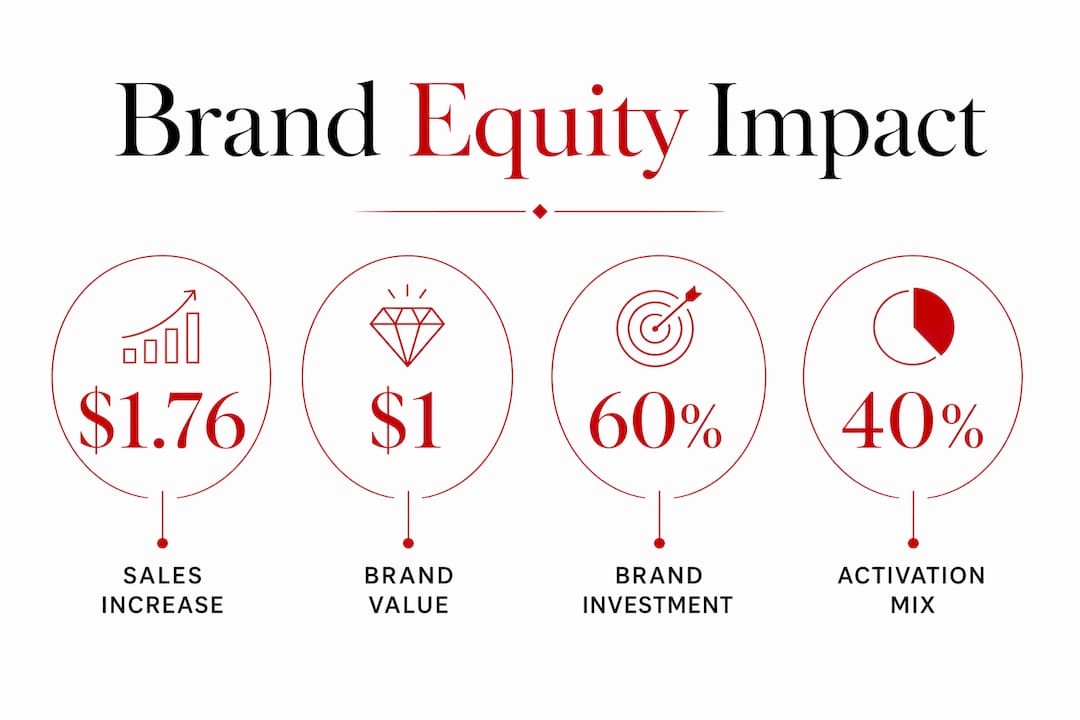
The financial case for brand equity is concrete and quantifiable. An international study of 135 companies covering 2005–2024 using Brand Finance and Bloomberg data found that a $1 increase in brand value correlates with approximately $1.76 in additional turnover and $0.16 in net income. That multiplier effect means brand investment is not a cost center. It is a compounding financial lever.
SKIM’s research on pricing dynamics adds an important layer. Brand trust makes higher prices feel natural over time, reducing the need for repeated short-term price negotiations. This is the mechanism luxury brands rely on. When a consumer already trusts a brand’s quality and identity, the price tag requires no justification. It is simply expected.
The contrast with discount-driven tactics is stark:
- Price promotions generate short-term volume spikes but train consumers to wait for deals, eroding the perceived value of the full-price offer.
- Brand equity investment builds a durable price floor. Consumers pay the premium because the brand has earned that position in their minds.
- Margin protection becomes a structural advantage rather than a quarterly negotiation when equity is strong.
- Competitive insulation increases. A brand with deep equity is harder to displace by a lower-priced competitor, even in a downturn.
SKIM warns explicitly that brand equity without pricing support can fail to translate into margin improvements. The two must work together. Equity sets the ceiling; pricing strategy determines how much of that ceiling you actually capture.
Pro Tip: Anchor your pricing strategy to brand perception data, not competitor benchmarks. If your brand equity scores are rising but your prices are not, you are leaving margin on the table.
How brand equity reduces customer acquisition costs
Marketing budgets in luxury sectors are substantial, and the return on that spend depends heavily on the brand’s existing equity position. NielsenIQ frames brand equity as a capital investment with a multiplier effect on sales and paid media ROI. A brand with strong equity converts paid impressions at a higher rate because the consumer already holds a positive prior. You are not starting from zero with every campaign.
The practical implications for marketing efficiency are significant:
- Lower cost per acquisition. Consumers familiar with and favorable toward a brand require fewer touchpoints before converting. Each media dollar works harder.
- Higher conversion rates at every funnel stage. Brand equity reduces friction at consideration, preference, and purchase. The consumer moves faster because trust is already established.
- Improved paid media performance. NielsenIQ data shows that brand equity reduces acquisition costs and improves conversion rates. Paid campaigns running against a strong brand baseline consistently outperform those running against a weak one.
- Stronger organic referral and word-of-mouth. High-equity brands generate unprompted advocacy. That is free acquisition at scale.
Many organizations undercount this effect because they treat brand building as an operating cost rather than a capital expenditure. The result is chronic underinvestment in equity and chronic overspend on activation to compensate.
Pro Tip: Balance your media mix between brand-building and activation. A rough 60/40 split in favor of brand investment is a starting point for luxury markets, but calibrate based on your equity tracking data and current funnel performance.
Does brand equity shape long-term consumer preference?
Brand equity shapes market positioning by establishing a brand as the obvious choice for consumers, strengthening shelf presence and creating durable preference that outlasts any single campaign. NielsenIQ describes this as “irresistibility,” the point at which a brand is not just preferred but instinctively chosen. For luxury brands, reaching that threshold is the difference between a loyal client base and a transactional one.

Consistent customer experience across all touchpoints builds and protects brand equity as a tangible business asset. ETBrandEquity highlights that experience failures damage equity more than launch failures. A single inconsistent interaction, whether in-store, digital, or post-purchase, can erode years of equity building. This is especially true in luxury, where the standard of expectation is set at the highest level.
The table below compares the outcomes of two strategic approaches:
| Dimension | Activation-Only Strategy | Equity-Led Growth Strategy |
|---|---|---|
| Price positioning | Requires frequent discounting to drive volume | Holds premium price with minimal promotion |
| Consumer loyalty | Transactional, price-sensitive repeat purchase | Emotional, identity-driven repeat purchase |
| Marketing efficiency | High spend required to maintain sales velocity | Lower cost per acquisition over time |
| Competitive resilience | Vulnerable to lower-priced entrants | Insulated by trust and brand association |
| Long-term margin | Erodes as promotions become expected | Grows as equity compounds |
The data is clear. Activation-only strategies produce results that are visible in the short term and damaging in the long term. Equity-led growth produces results that are slower to appear and far harder to reverse. For luxury brands, where the client relationship is the product, the choice is not a close call.
Explore how premium branding examples from leading luxury houses translate equity into instinctive consumer preference.
How to measure brand equity for executive decision-making
Measuring brand equity is not a soft exercise in brand sentiment. It is a financial modeling discipline. Linking brand perceptions to economic drivers like pricing power, retention, and customer acquisition cost allows executives to quantify the future cash flow impact of brand investments. That is the language of the boardroom, and it is the only way brand equity earns its seat there.
Investors and employees increasingly consider brand equity a tangible business asset requiring consistency and strategic governance. This shift in perspective changes how brand budgets get approved and how brand performance gets reported. The brands winning this conversation are the ones that have built a measurement framework connecting perception data to financial outcomes.
The table below outlines the key metrics that matter most:
| Metric | What It Measures | Why It Matters |
|---|---|---|
| Pricing headroom | Gap between current price and consumer willingness to pay | Reveals untapped margin potential |
| Customer retention rate | Percentage of buyers who return without a promotional trigger | Signals depth of brand loyalty |
| Customer acquisition cost | Spend required to convert a new buyer | Tracks equity’s efficiency multiplier on paid media |
| Activation effectiveness | Conversion rate of brand-aware consumers | Separates equity gaps from activation gaps |
| Brand trust score | Consumer perception of credibility and reliability | Predicts long-term pricing power and resilience |
Separating brand equity building from activation diagnostics is a critical discipline. NielsenIQ notes that weak sales may reflect a lack of consumer equity or poor activation strategies like pricing or promotions. Misdiagnosing the cause leads to the wrong fix. Spending more on promotions when the real problem is low brand trust will not move the needle. It will accelerate the erosion.
For a deeper look at how luxury brand equity functions as a strategic asset, the full framework is worth reviewing before your next planning cycle.
Key takeaways
Brand equity is a capital asset that directly drives pricing power, marketing efficiency, and consumer loyalty, making it the foundation of sustainable luxury brand performance.
| Point | Details |
|---|---|
| Equity drives financial returns | A $1 gain in brand value correlates with $1.76 in turnover, per Brand Finance data. |
| Trust protects pricing power | Brand trust makes premium prices feel natural, reducing reliance on discounts. |
| Equity lowers acquisition costs | Strong brand equity reduces friction at every funnel stage, improving paid media ROI. |
| Consistency protects equity | Experience failures damage brand equity more than launch failures, per ETBrandEquity. |
| Measure equity as a capital asset | Link brand perception metrics to pricing headroom, retention, and acquisition cost. |
The mistake most luxury executives make with brand equity
I have worked with luxury brands that had genuinely strong equity and were systematically destroying it. Not through bad products or poor service. Through the quarterly pressure to show efficient marketing numbers. Every time a brand cuts brand-building spend to hit a short-term ROI target, it is borrowing against future margin. The debt is invisible until it is not.
The most common pitfall I see is treating brand equity as the marketing team’s problem. It is not. It belongs on the P&L, in the investor deck, and in the CEO’s strategic priorities. Long-term brand investment delivers durable margins by embedding trust and credibility. That is a finance conversation, not a creative one.
What actually works is building a measurement system that connects brand perception to financial outcomes. When you can show the board that a 10-point increase in brand trust score correlates with a measurable reduction in customer acquisition cost, the conversation about brand investment changes completely. You are no longer defending a budget. You are presenting a return.
The brands I have seen sustain premium positioning through market disruptions, recessions, and competitive pressure all share one trait. They never stopped investing in reputation and trust as a core strategic priority. That consistency is not a soft value. It is the hardest competitive advantage to replicate.
— Corrado
Build your luxury brand equity with Corradomanenti
The financial case for brand equity is clear. The harder question is how to build, protect, and activate it in a way that fits your specific market position and consumer psychology.
Corradomanenti works with luxury fashion and lifestyle brands to translate brand equity principles into concrete growth strategies. From fashion brand growth tactics grounded in consumer psychology to buyer behavior analysis that reveals what actually drives purchase decisions in your category, the work is built for executives who need results, not theory. If your brand is ready to treat equity as the asset it is, the next step starts here.
FAQ
What is brand equity and why is it important?
Brand equity is the measurable value a brand holds based on consumer perception, trust, and emotional association. It is important because it directly drives pricing power, customer loyalty, and long-term financial performance.
How does brand equity affect sales and revenue?
Research covering 135 companies shows a $1 increase in brand value correlates with $1.76 in additional turnover. Strong brand equity also reduces customer acquisition costs and improves conversion rates at every funnel stage.
Why does brand equity matter more than short-term promotions?
Short-term price promotions generate volume spikes but erode the perceived value of the full-price offer over time. Brand equity builds a durable price floor that protects margins without requiring constant discounting.
How do luxury brands measure brand equity effectively?
Effective measurement links brand perception metrics like trust scores and credibility ratings to financial drivers including pricing headroom, retention rates, and customer acquisition cost. This approach connects brand investment to quantifiable cash flow impact.
What is the biggest risk of ignoring brand equity investment?
Brands that underinvest in equity and rely on activation tactics alone become price-sensitive and vulnerable to lower-cost competitors. NielsenIQ identifies this as treating brand building as an operating cost rather than a capital investment, which systematically undervalues its long-term return.